Coffee Stand Up Pouches
Custom stand up pouches for whole bean coffee, ground coffee, retail coffee brands, and subscription coffee packaging.
For coffee roasters and private-label brands, pouch structure affects aroma protection, CO₂ release, resealing, and shelf presentation. ScintrixPackaging helps confirm pouch size, valve position, zipper placement, barrier film structure, print layout, and sample approval before mass production.
so your coffee stand up pouches can match filling, sealing, and retail display requirements.
- One-Way Valve Options for Roasted Coffee
- Barrier Films for Aroma, Oxygen, and Moisture Control
- Resealable Zipper for Daily Coffee Use
- Custom Printing for Roast Level, Origin, and Barcode Layout
What Are Coffee Stand Up Pouches?
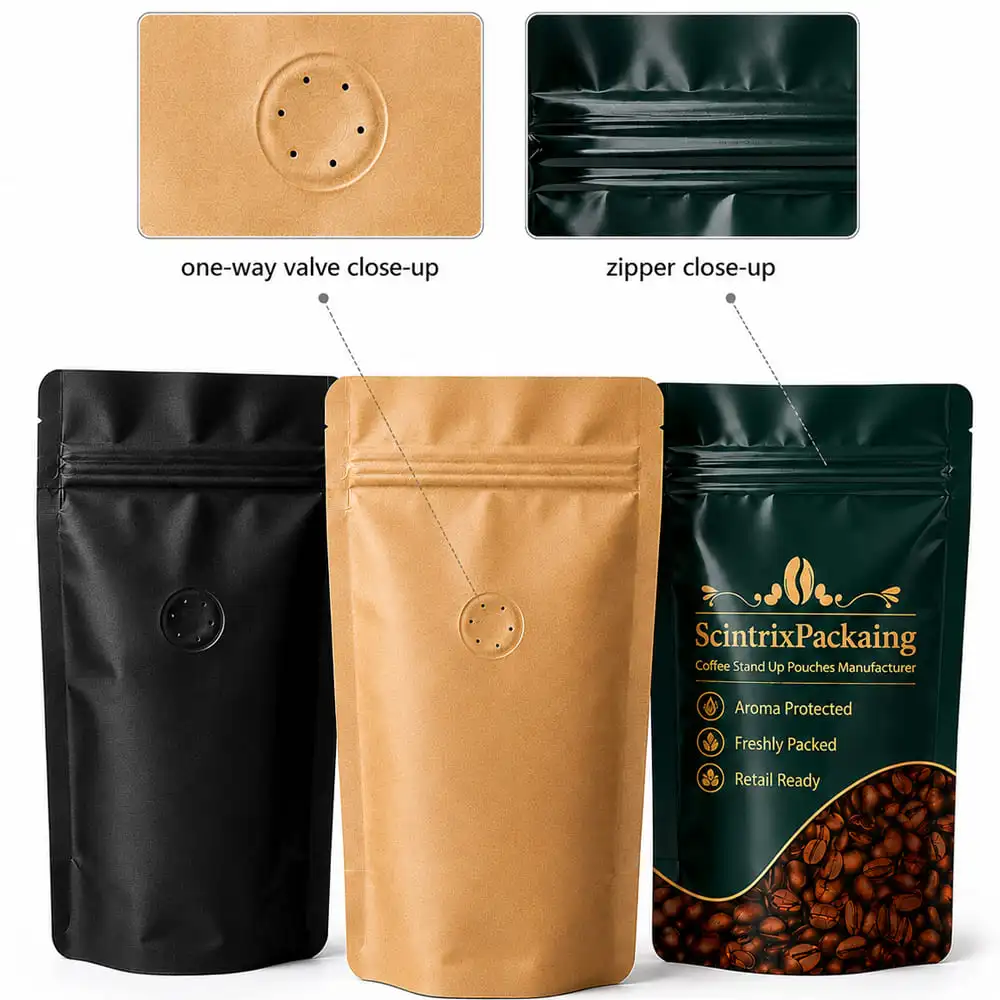
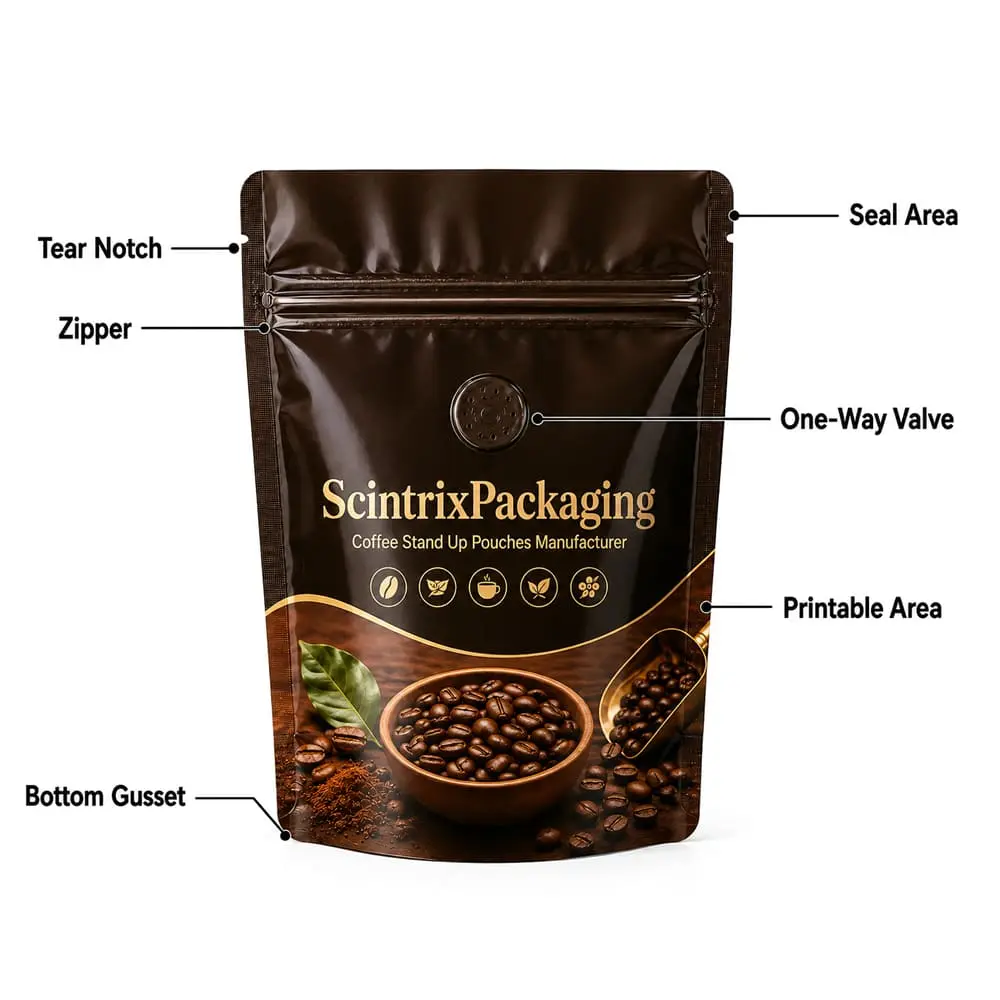
Coffee stand up pouches are flexible coffee packaging bags with a bottom gusset that allows the pouch to stand upright, with optional one-way degassing valves, resealable zippers, barrier film structures, and custom printing for whole bean and ground coffee products.
The bottom gusset helps the filled pouch keep a stable shape on retail shelves or in subscription boxes. For freshly roasted whole bean coffee, a valve option can help release CO₂ from the pouch. For daily coffee use, a zipper allows repeated opening and resealing, while barrier structures help reduce oxygen and moisture exposure while supporting aroma retention.
Note: Coffee stand up pouches differ from flat bottom coffee bags (which have a completely flat, square base) and side gusset coffee bags (which expand through side panels and are often used for classic coffee packaging formats, while coffee stand up pouches rely on a bottom gusset to stand upright on shelves).
Why Coffee Brands Use Stand Up Pouches
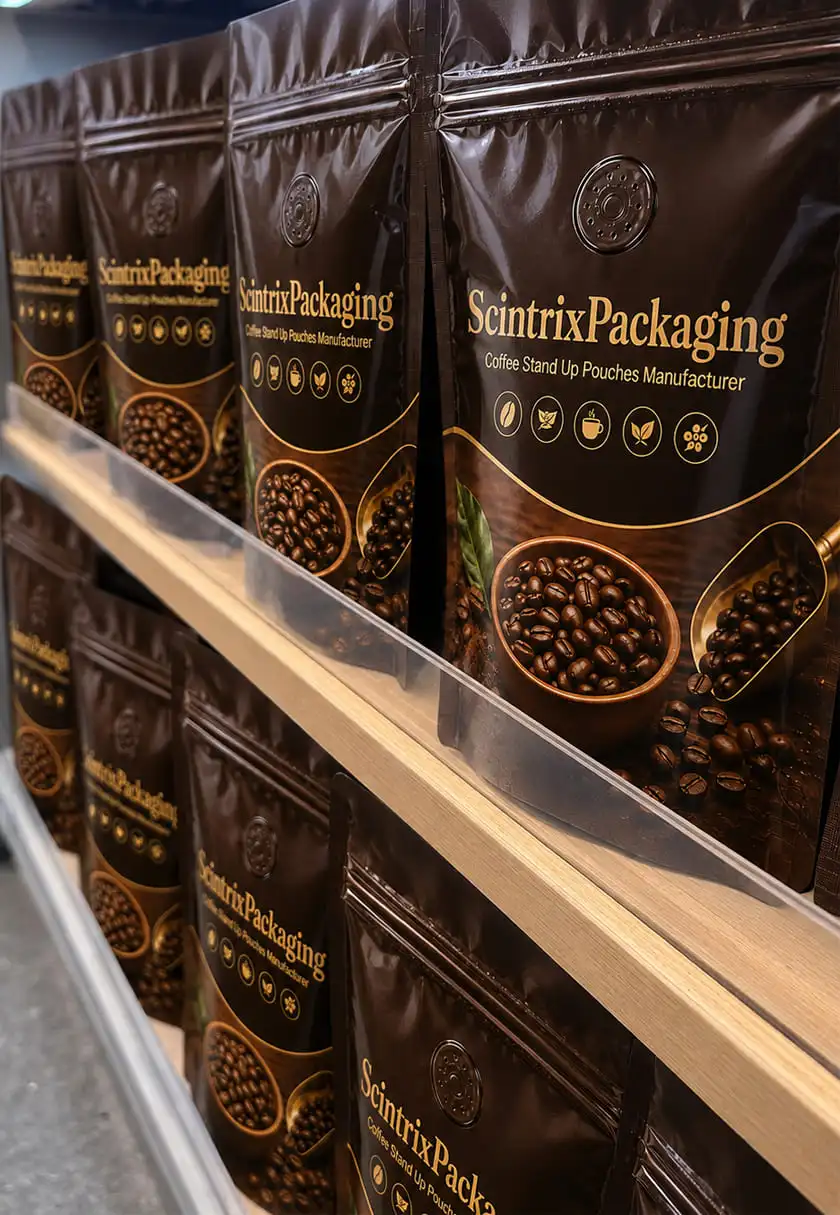
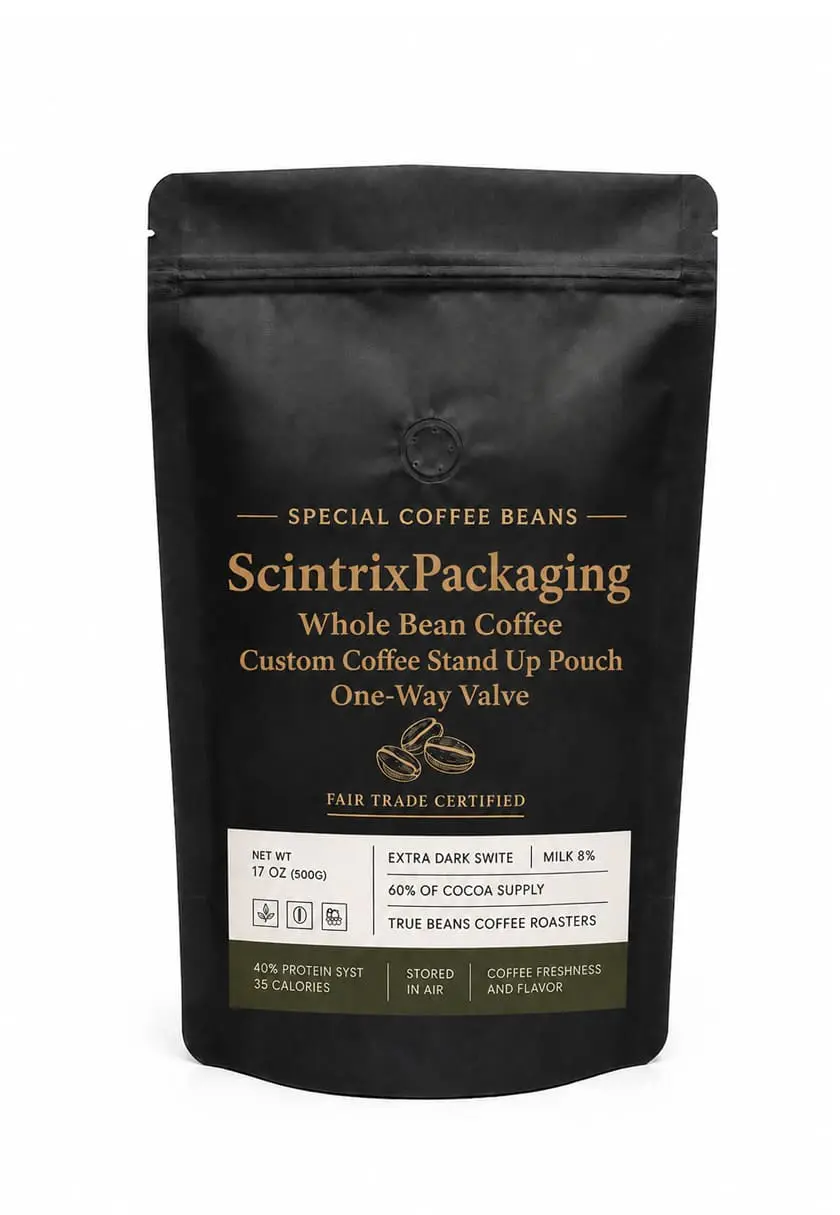
Coffee brands use stand up pouches when they need a coffee bag that can stand on retail shelves, support valve and zipper options, and carry clear roast information for different origins or subscription SKUs.
For a coffee roaster selling whole bean coffee through retail stores and online subscriptions, the pouch must manage CO₂ release, resealing after opening, barcode readability, and shelf presentation. A custom coffee stand up pouch can combine a bottom gusset, one-way valve, resealable zipper, and printed roast information in one flexible format.
Shelf-Ready Display
The bottom gusset helps filled coffee pouches stand upright on shelves or in product photos. This is useful for 8 oz, 12 oz, and 1 lb retail coffee projects where front-panel printing, barcode placement, and pouch shape affect shelf recognition.
Valve and Zipper Options
Freshly roasted whole bean coffee may require a one-way degassing valve, while ground coffee and daily-use packs often need a resealable zipper. Valve position, zipper placement, and seal area should be confirmed before production.
Room for Coffee Brand Information
Front and back panels can carry origin, roast level, flavor notes, roast date, best-before date, barcode, QR code, and batch information. This helps multi-origin coffee brands keep packaging clear across different SKUs.
Flexible Planning for Samples and Subscriptions
Coffee stand up pouches can be planned for 2 oz sample packs, 4 oz trial packs, 12 oz retail bags, and subscription coffee packaging when fill weight, pouch width, bottom gusset depth, and carton packing method are confirmed.
Solving Common Coffee Packaging Challenges
Practical packaging solutions for whole bean, ground, and multi-SKU coffee projects.
1. Coffee Aroma Loss
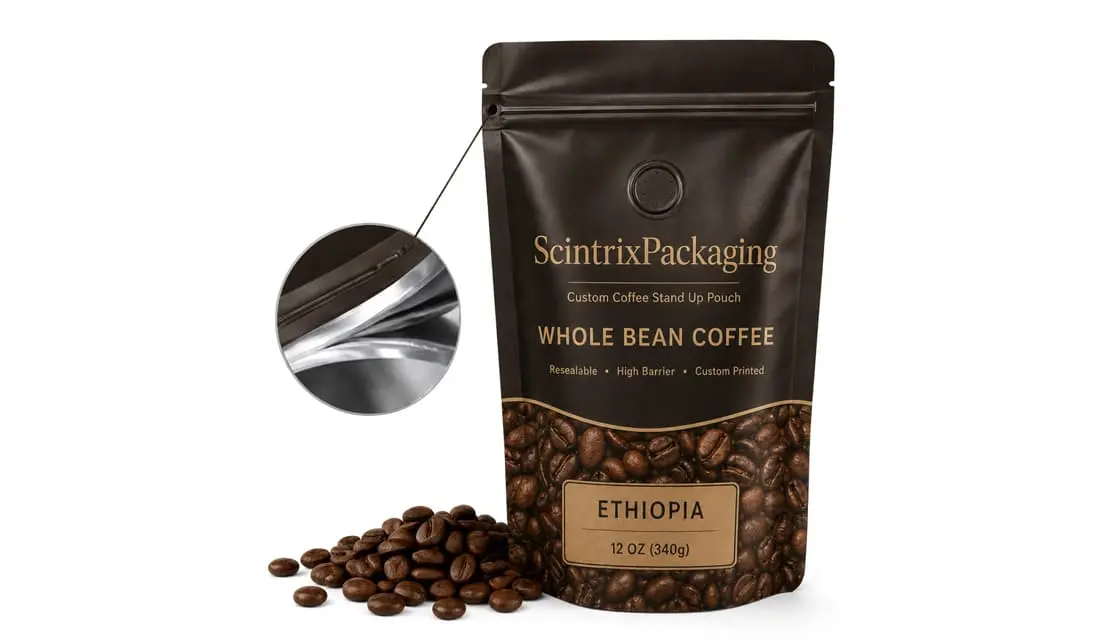
When packing aroma-sensitive whole bean or ground coffee, standard films may allow flavor degradation. ScintrixPackaging recommends barrier materials and confirms seal area cleanliness and zipper reclosure integrity to help reduce exposure to external odors and retain the coffee's profile.
2. Oxygen and Moisture Exposure
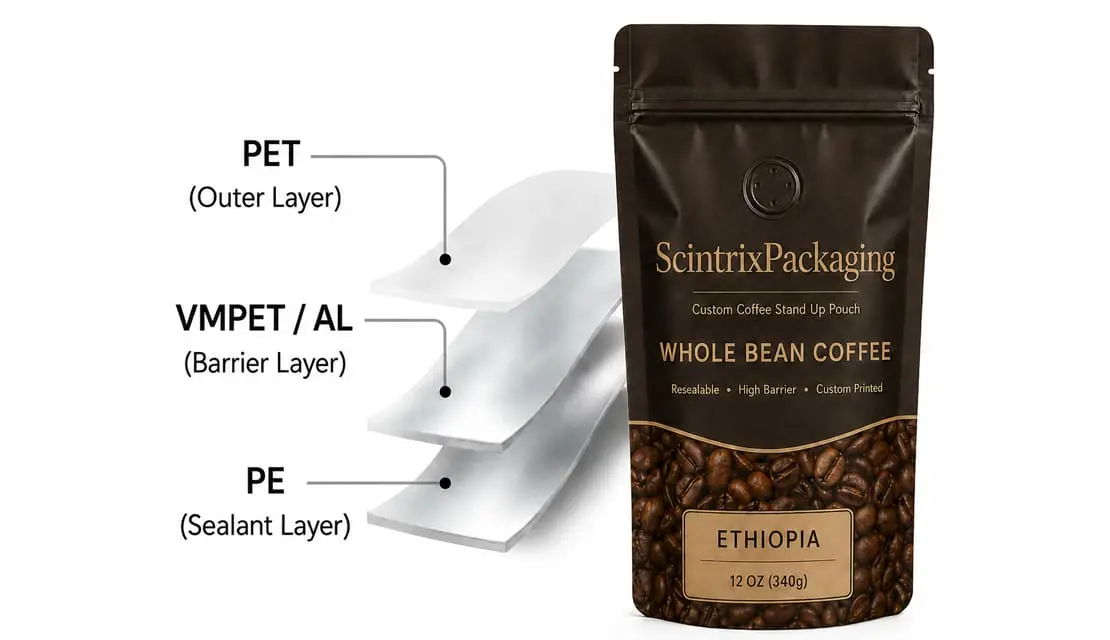
Coffee oils and flavor stability are compromised by oxygen and moisture. Based on storage conditions, we help select barrier structures like PET/VMPET/PE or PET/AL/PE to provide a stronger oxygen and moisture barrier direction, protecting the coffee prior to opening.
3. Degassing and Valve Selection
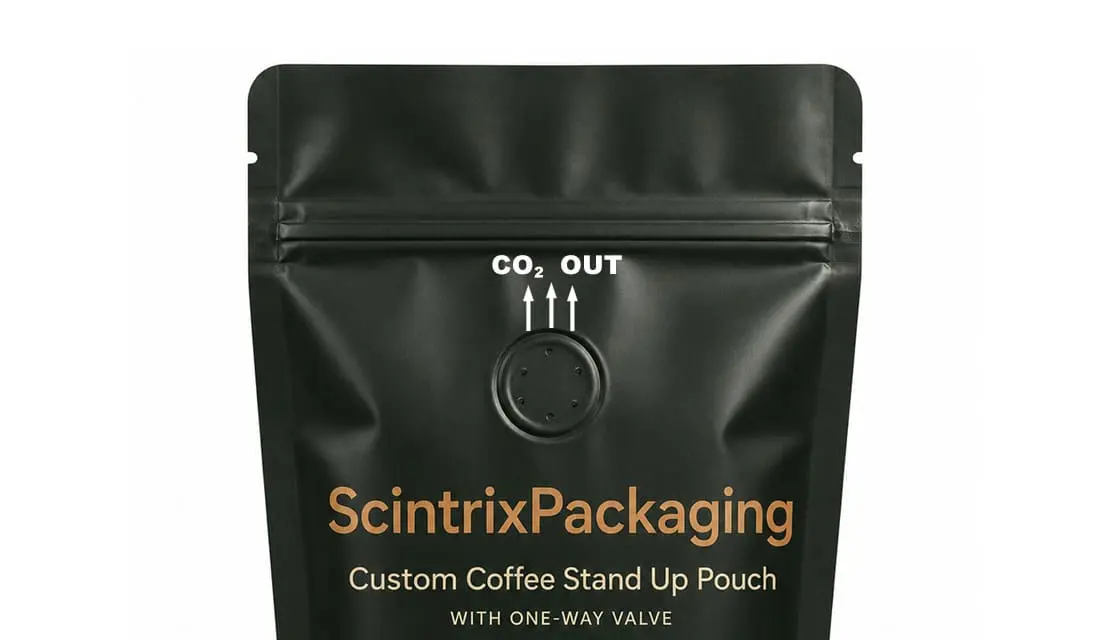
Freshly roasted whole bean coffee releases CO₂. Without a valve, pouches can bloat or burst. A one-way degassing valve helps release CO₂ while limiting oxygen ingress. We review valve position based on pouch size, roast date, and filling method.
4. Shelf Stability & Gusset Structure
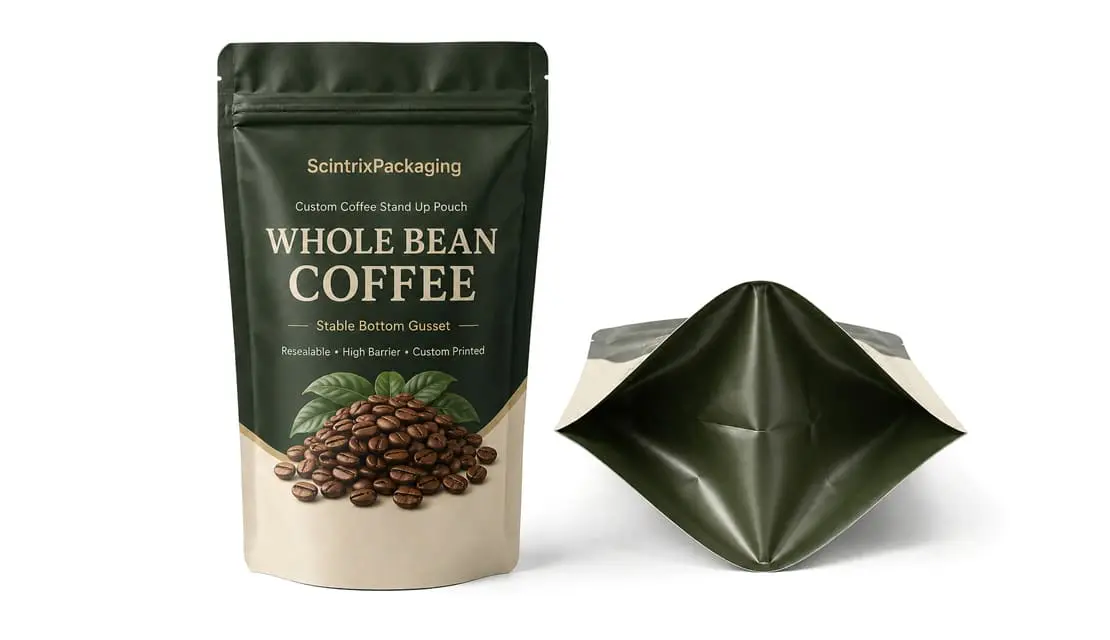
For 8 oz, 12 oz, or 16 oz project directions, a poorly designed bottom gusset causes pouches to tip over. We evaluate coffee weight, filled-pouch shape, and film stiffness to ensure the bottom gusset provides reliable shelf presentation.
5. Zipper and Resealing Experience
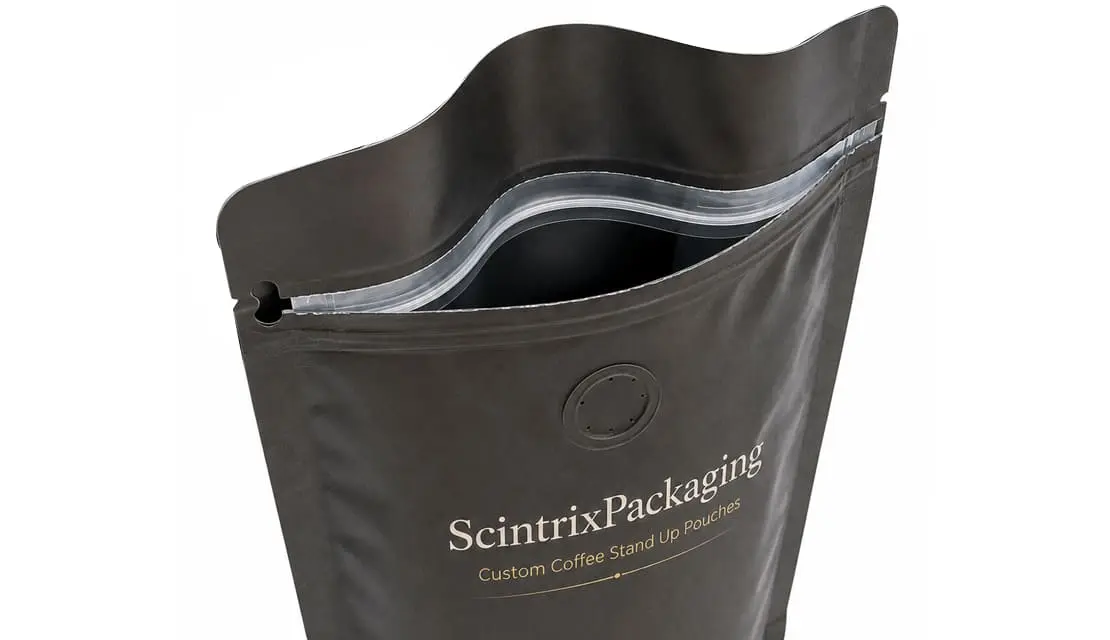
Daily opening requires a durable resealable zipper. We confirm zipper position and bag opening width to ensure consumer handling is easy, and review designs to minimize ground coffee dust interfering with the zipper tracks.
6. Structure Selection by Format
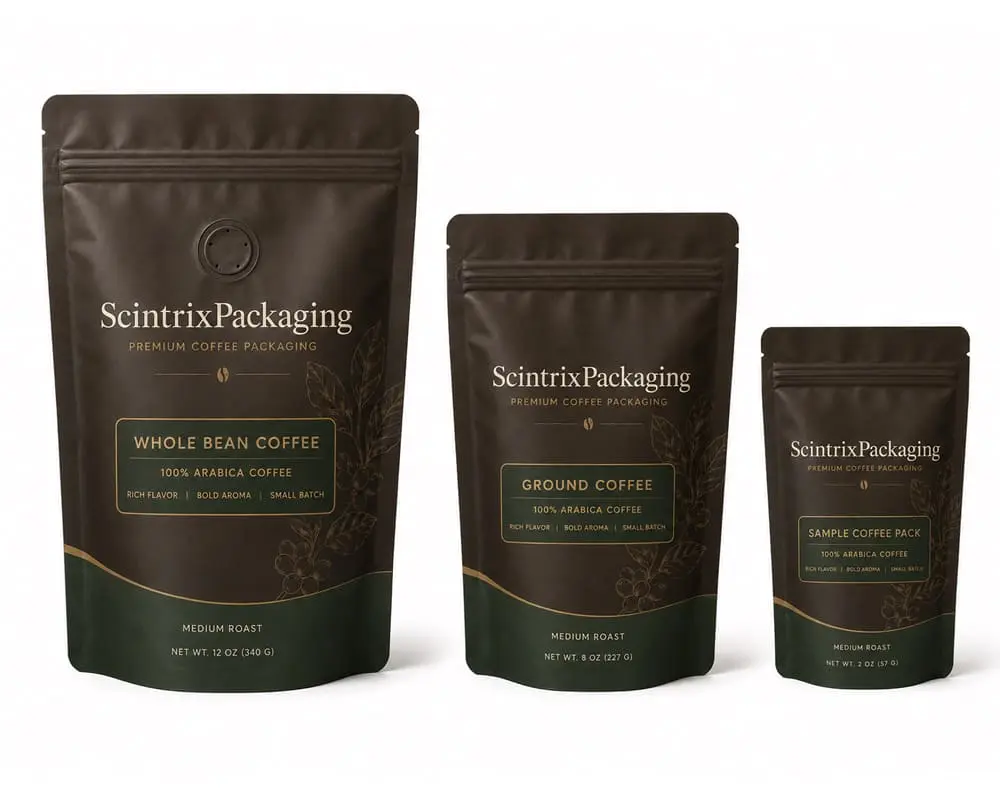
Whole bean coffee, ground coffee, and sample coffee pouches have different requirements. We help evaluate valve needs, oxygen/moisture barrier levels, and pouch size to recommend the appropriate material structure for the specific coffee format.
7. Multi-SKU Inventory Pressure
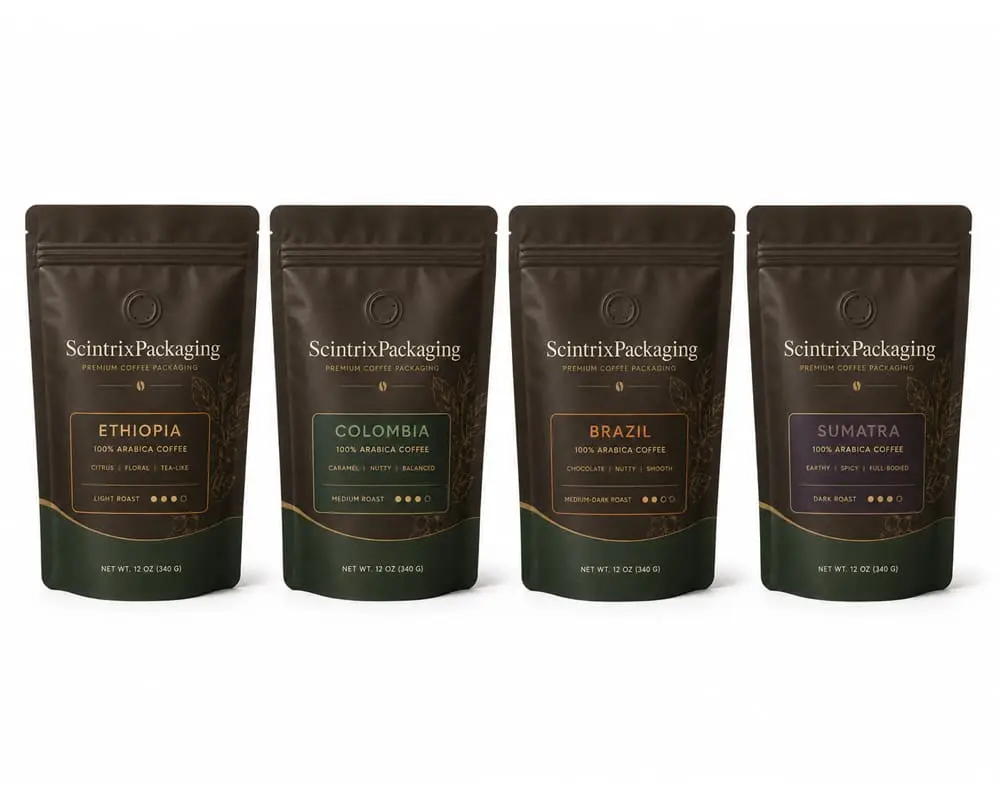
Brands managing different origins, roast levels, flavors, and subscription versions face artwork complexity. We facilitate custom printed coffee pouches with structured sample approval to ensure consistency across multiple SKUs and net weights.
8. Filling and Sealing Compatibility
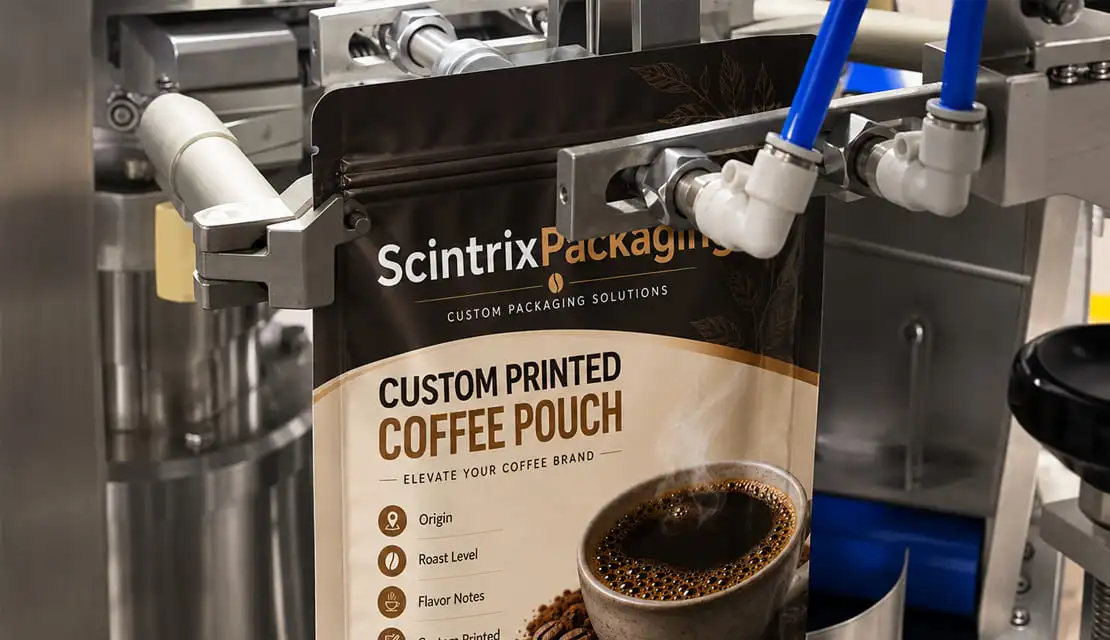
Whether using manual, semi-automatic, or automatic filling, the pouch opening width, seal area, valve position, and zipper placement must align with the equipment. We review these details to support production consistency.
Coffee Stand Up Pouches by Application
Tailored packaging directions for beans, ground, retail, and subscription formats.
Coffee Bean Pouches
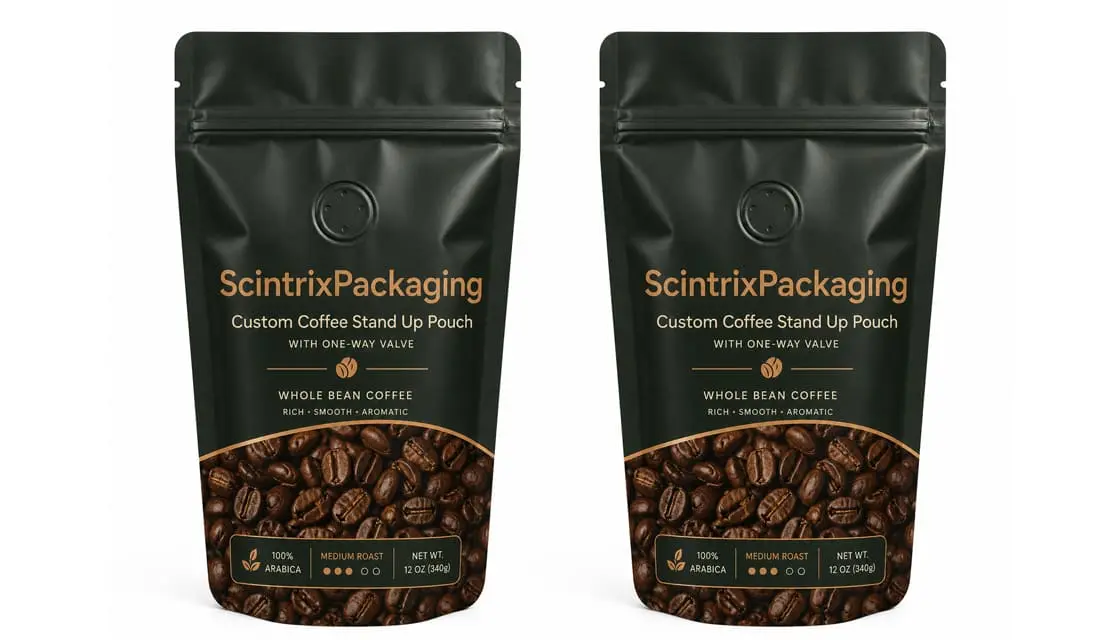
Focuses on managing CO₂ release from whole bean coffee. We plan valve options and aroma retention directions for retail sizes such as 8 oz, 12 oz, or 1 lb projects.
Ground Coffee Pouches
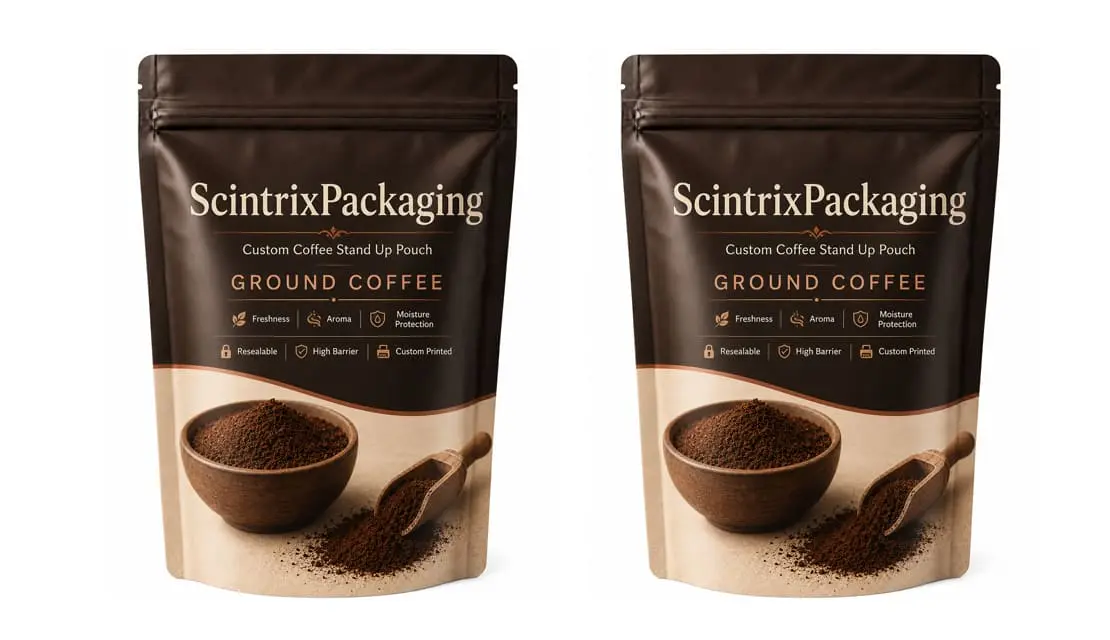
Addresses oxygen and moisture exposure. We review zipper and seal area design to handle powder-like particles and recommend barrier films for ground coffee stability.
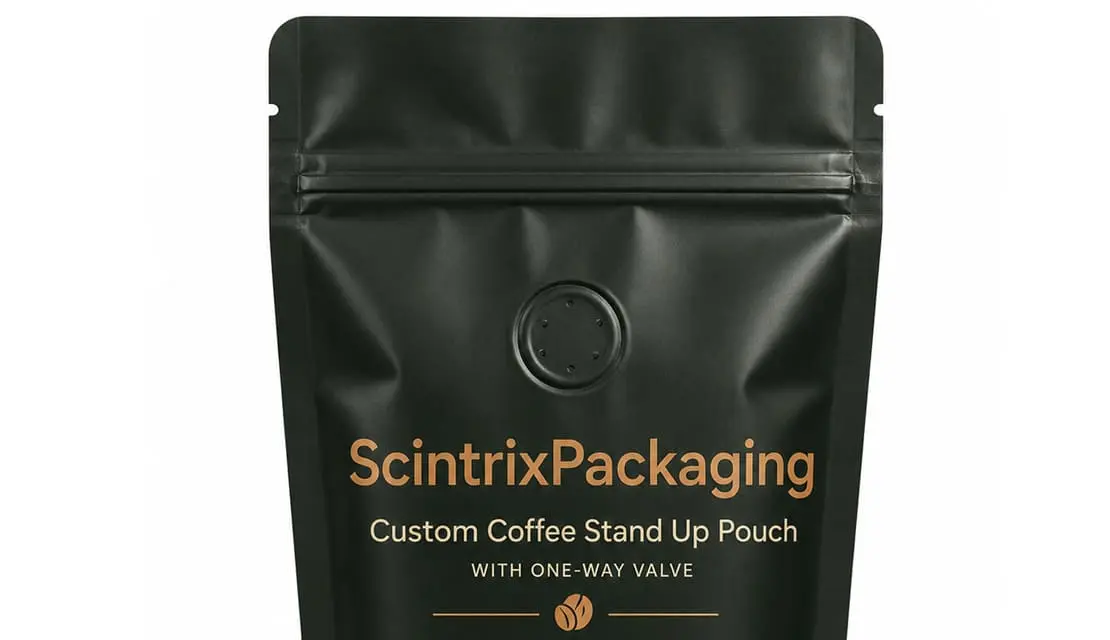
Pouches with Valve
Integrates a one-way degassing valve for freshly roasted coffee. Valve position is carefully aligned with roast date requirements, bag size, and whole bean fill volume.
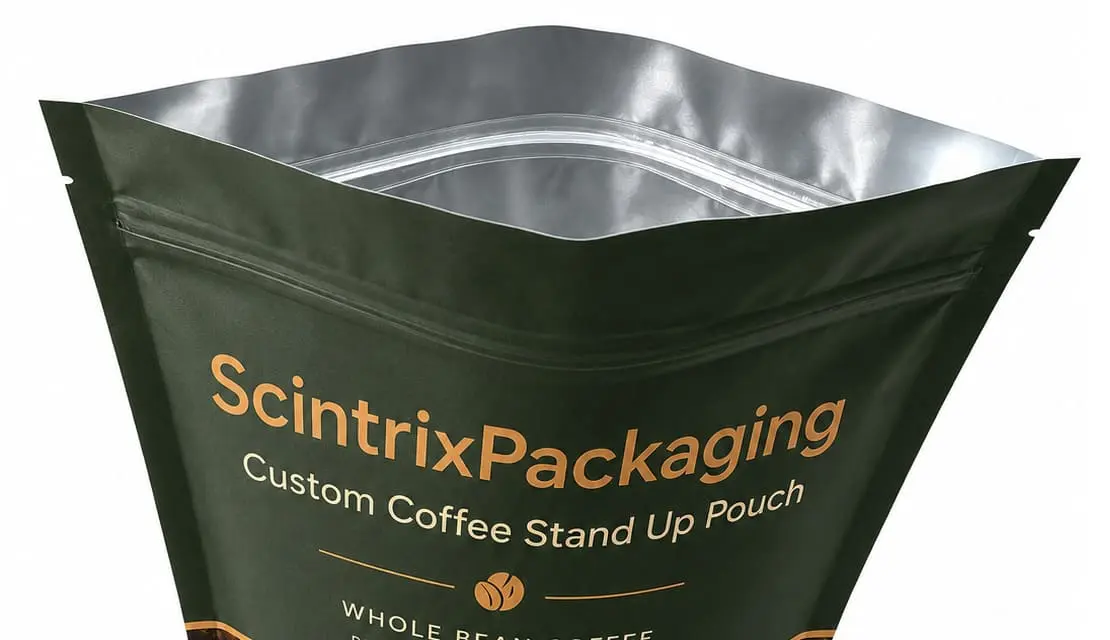
Resealable Pouches
Designed for repeated opening by the consumer. We confirm zipper position and bag opening width to help maintain coffee aroma protection after the initial opening.
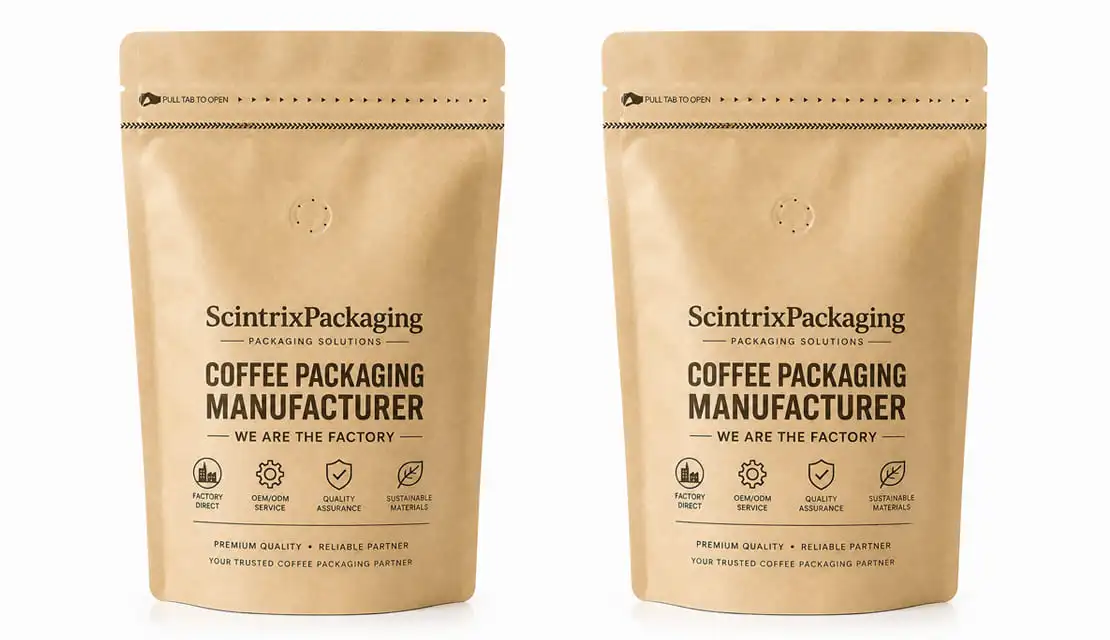
Kraft Coffee Pouches
A kraft paper laminate exterior for a natural brand presentation. An inner barrier layer is required for protection, compatible with zipper and valve options.
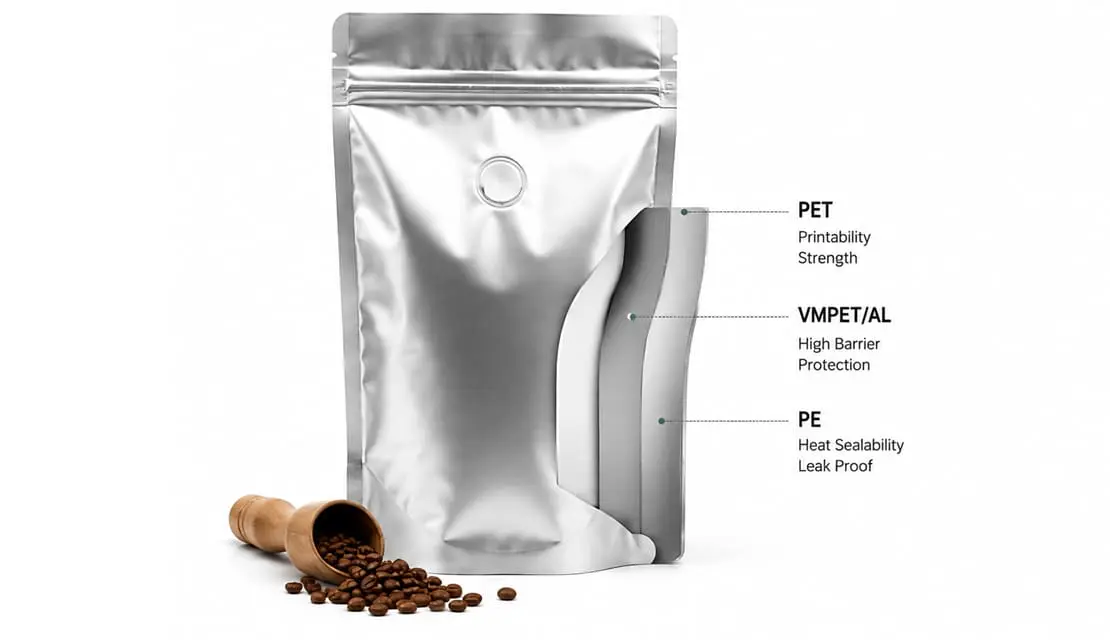
Foil Coffee Pouches
Utilizes PET/VMPET/PE or PET/AL/PE for a stronger light, oxygen, and moisture barrier direction. This opaque appearance is suited for ground coffee or aroma-sensitive roasts.
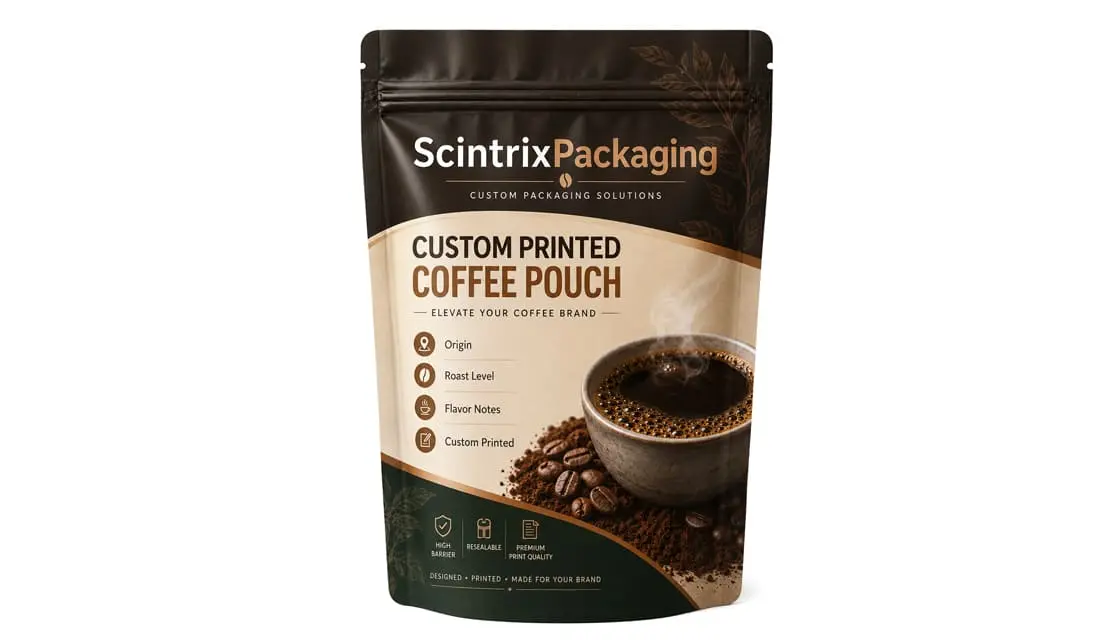
Custom Printed Pouches
Facilitates private label layouts. We help organize print areas for origin, roast level, flavor notes, roast date, barcode, and QR code to ensure clear communication.
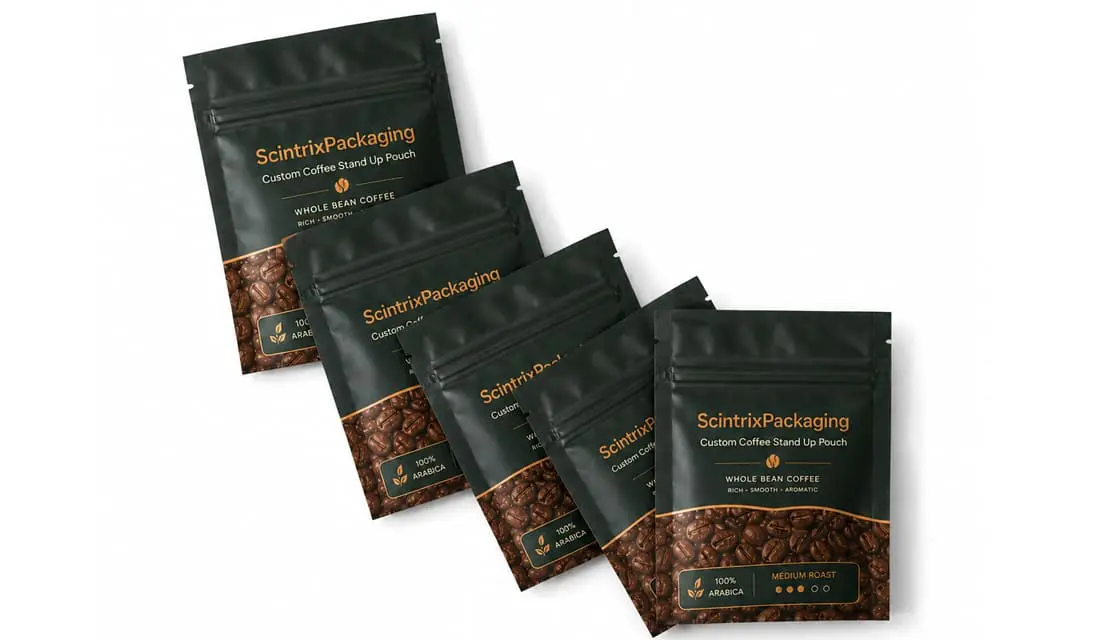
Sample Coffee Pouches
Ideal for 2 oz or 4 oz trial packs and subscription samples. We review small pouch consistency, tear notch placement, and custom print area optimization.
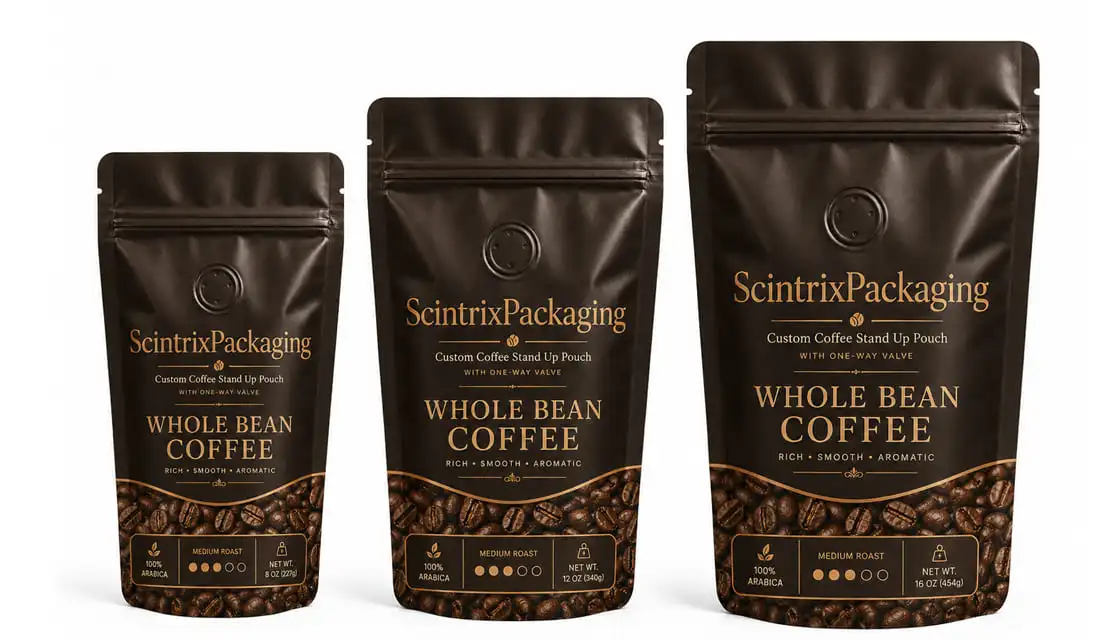
Retail Coffee Pouches
Built for shelf display in 8 oz, 12 oz, or 16 oz project directions. Focuses on bottom gusset stability, front panel printing impact, and barcode readability.
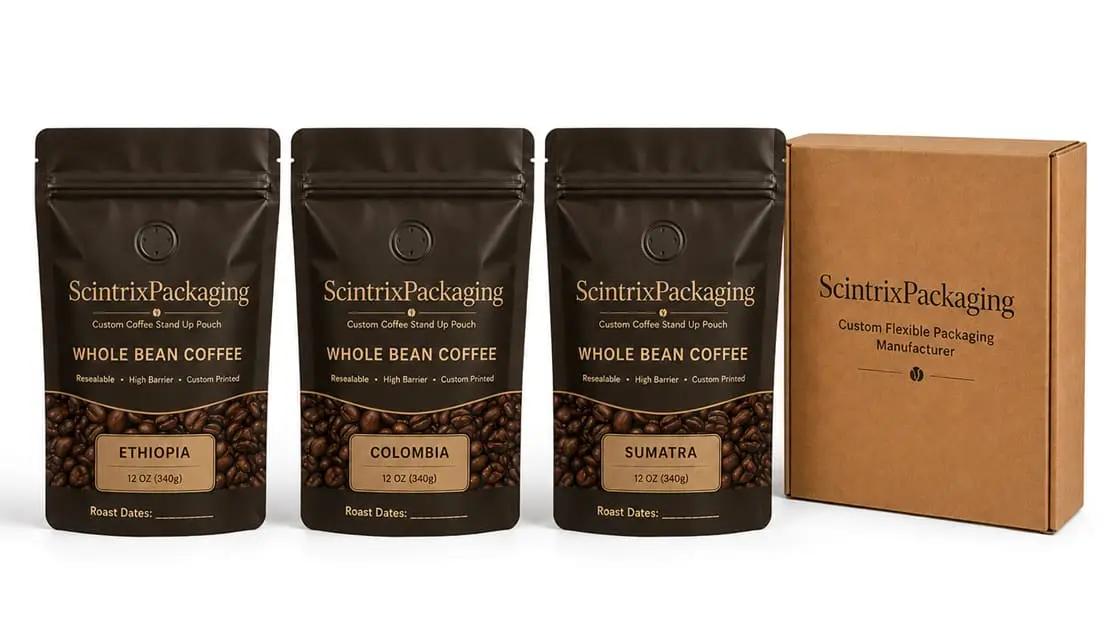
Subscription Pouches
Mailer-friendly pouch planning for multi-origin versions. We ensure batch-to-batch print consistency and designate clear areas for roast dates on repeat orders.
Explore more materials and finishes for your coffee pouches:
Core Structural Features
Configurable elements to match your coffee filling, sealing, and consumer use requirements.
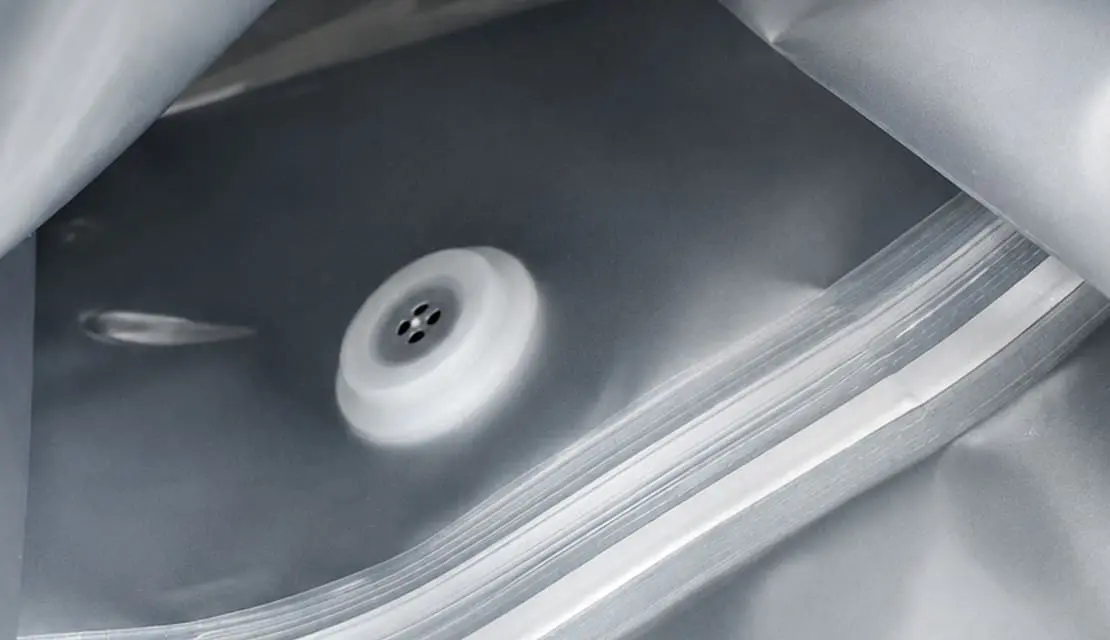
One-Way Degassing Valve
Freshly roasted coffee releases CO₂. A valve helps release this gas while helping limit oxygen and moisture ingress. The valve position should match the pouch size, roast date, and filling method to function correctly.
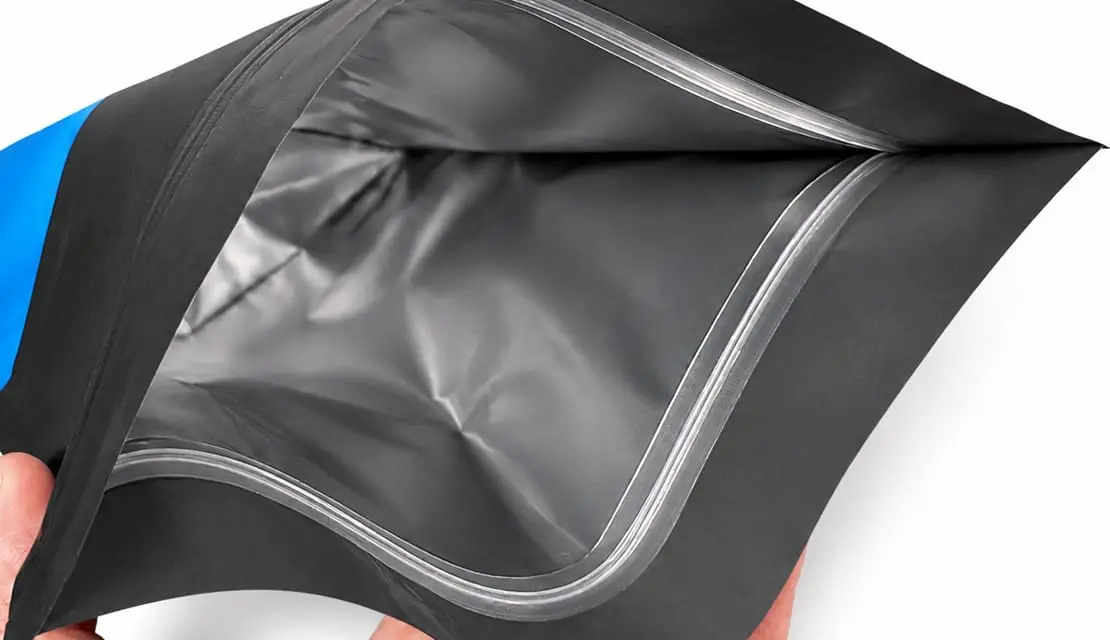
Resealable Zipper
Essential for repeated use. We review zipper placement, bag opening width, and the potential for ground coffee dust to interfere with the track, ensuring a smooth customer handling experience.
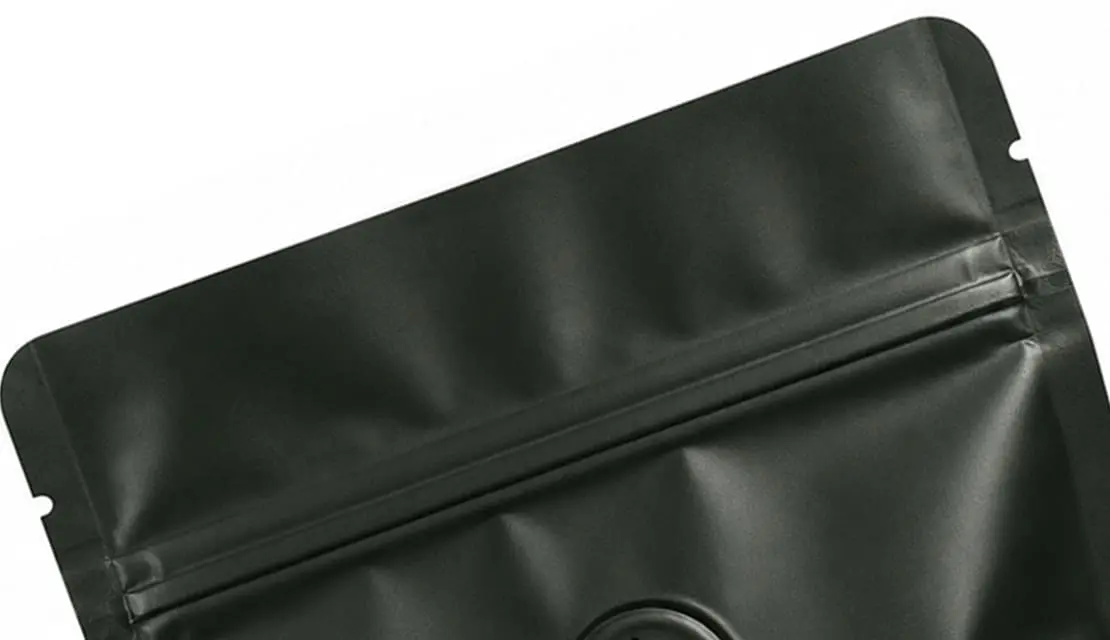
Tear Notch
Provides controlled opening for the end consumer. Tear notches are standard on sample packs and retail pouches, placed just above the zipper for clean access to the resealable track.
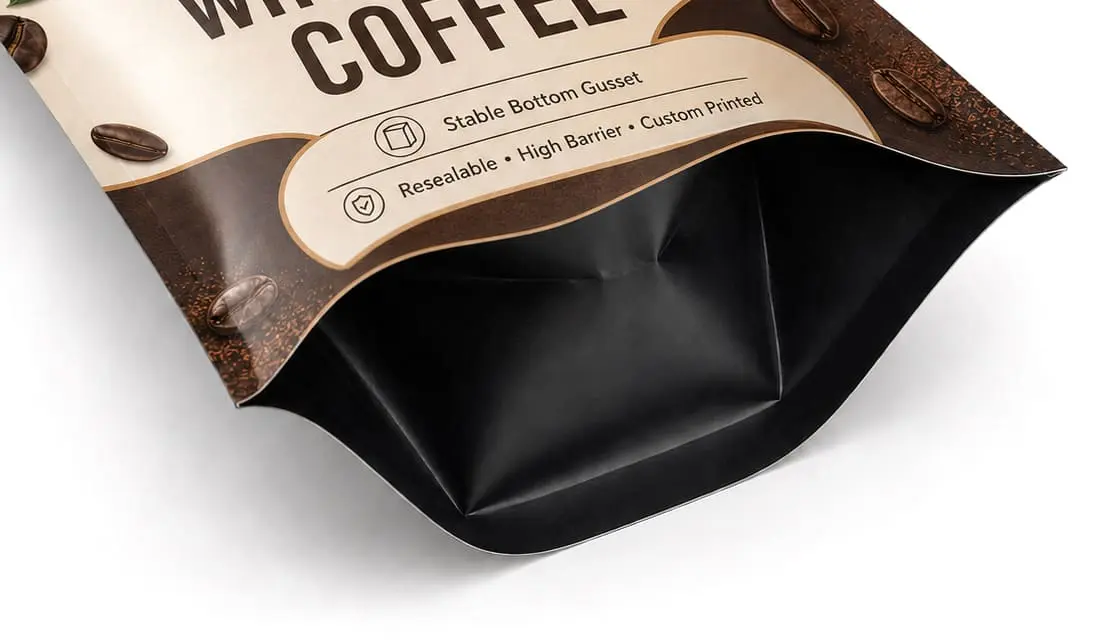
Bottom Gusset
Enables shelf standing. The depth of the gusset must be calculated based on fill weight, desired bag shape after filling, and film stiffness to prevent the pouch from tipping over on display.
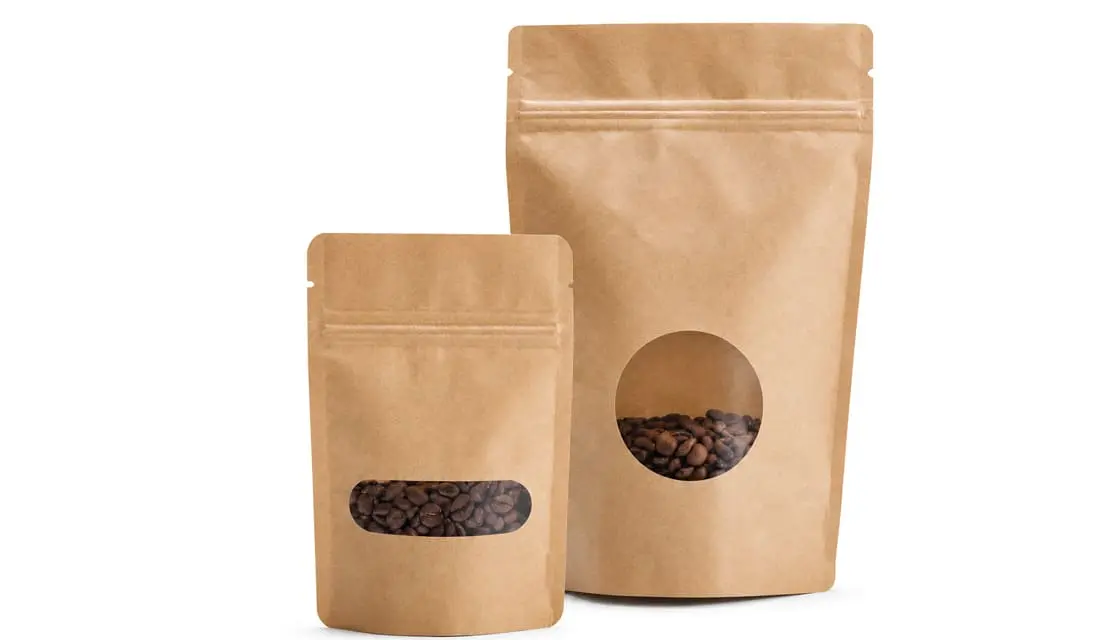
Transparent Window
Allows product visibility for coffee bean display. We carefully review window size and position, noting that adding a window reduces the overall light barrier of the pouch.
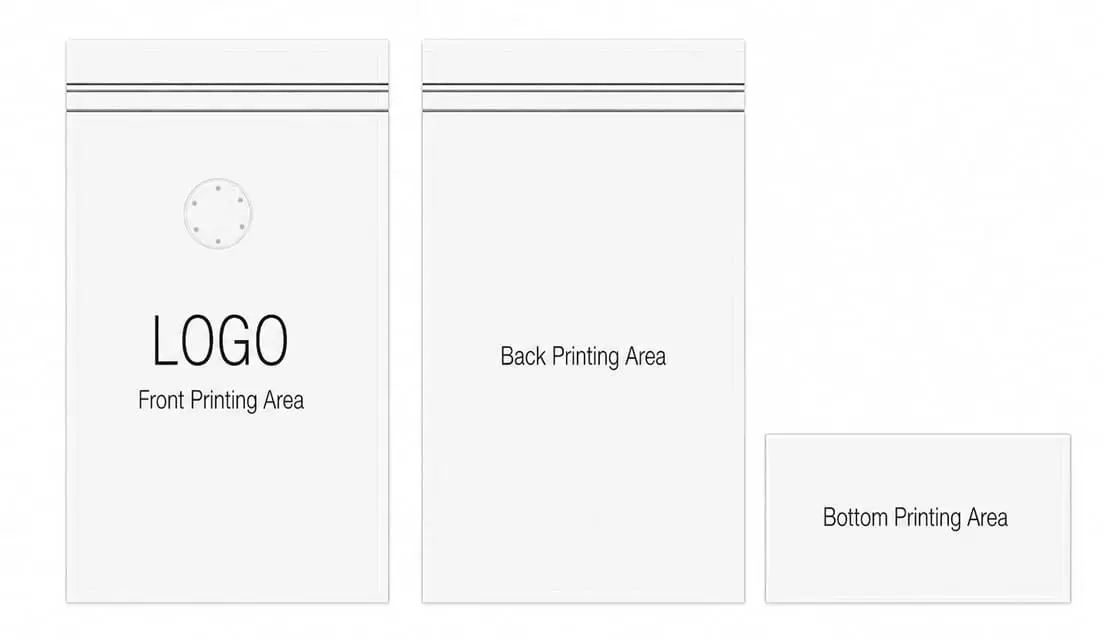
Custom Printing
Utilizes the front, back, and bottom gusset panels to display origin, roast level, flavor notes, net weight, roast date, barcode, and QR code, essential for brand communication.
Coffee Pouch Material Structures
Material selection depends on whether you are packing whole bean or ground coffee, the roast level, oil content, and aroma sensitivity. We evaluate oxygen and moisture sensitivity, valve/zipper requirements, pack weight, desired window placement, storage conditions, and transportation routes to recommend the appropriate structure.
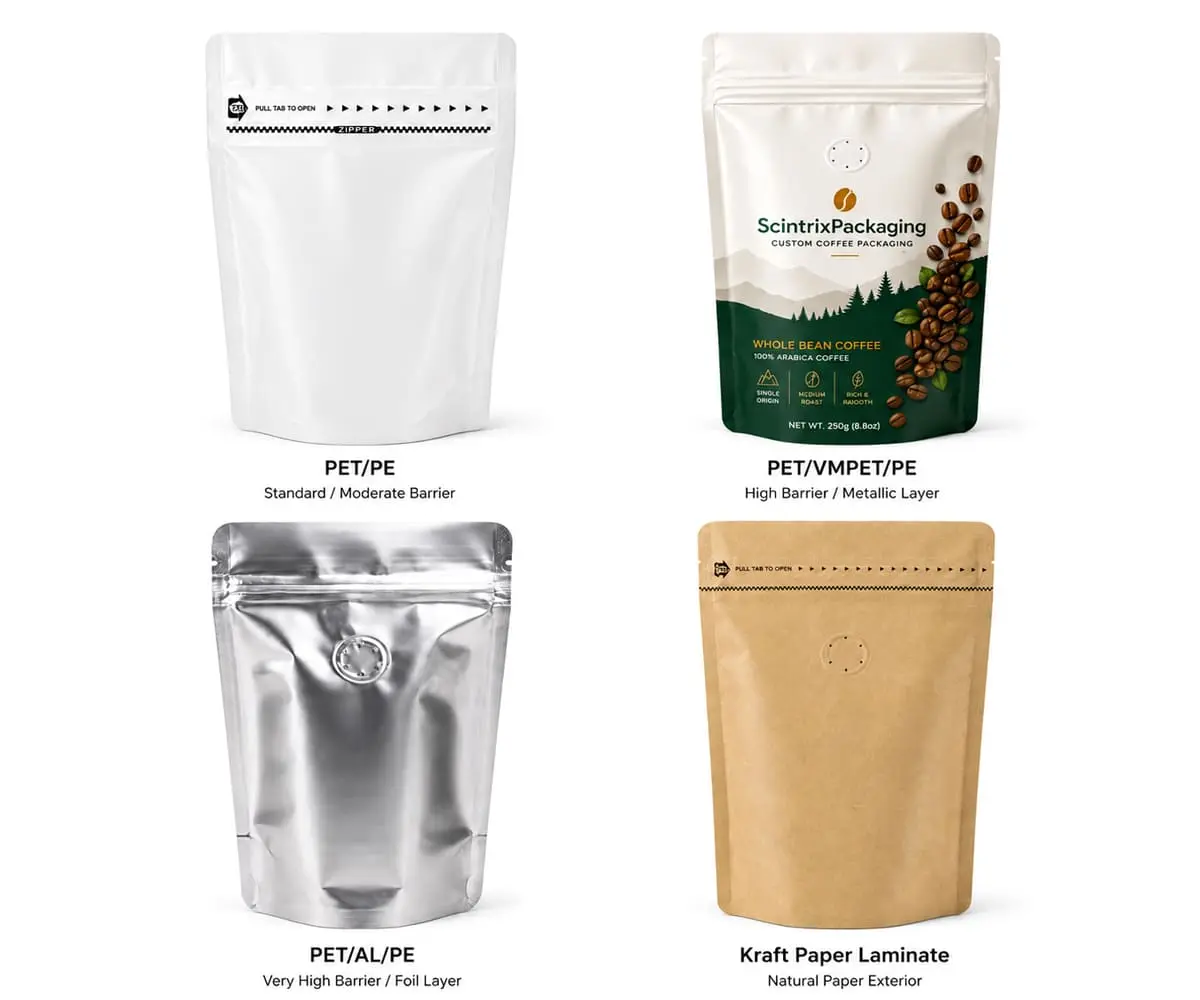
PET/PE
PET supports printing and dimensional stability, while PE acts as the heat sealing and product contact layer. This is suitable for selected coffee pouch projects where barrier needs are moderate. It is not recommended for highly sensitive or long-shelf-life coffee products.
PET/VMPET/PE
The metallized (VMPET) layer provides a stronger light and oxygen barrier direction. It is suitable for aroma-sensitive coffee products where product visibility is not required, offering excellent support for matte or metallic visual directions.
PET/AL/PE
An aluminum foil laminate may be considered when a stronger moisture, oxygen, and light barrier direction is needed. This opaque structure is suitable for ground coffee or sensitive roast profiles when confirmed by project requirements.
Kraft Paper Laminates
The kraft exterior supports a natural coffee brand appearance. Protection depends entirely on the inner barrier and sealant layers. It can be used with zipper and valve options depending on pouch design.
Recyclable Mono-Material Structures
Can be considered for selected markets and coffee products. These must be evaluated according to barrier requirements, heat sealing performance, stiffness, zipper compatibility, and local recycling infrastructure.
Finishes
We offer matte, gloss, soft touch, metallic effects, and spot UV. These finishes help with shelf recognition, origin separation, and premium coffee line identification, rather than just appearance.
| Material Structure | Barrier Direction | Appearance | Suitable Coffee Use | Important Limitation |
|---|---|---|---|---|
| PET/PE | Moderate | Clear / Printed | Short-term / Fast turnover | Lower oxygen/moisture barrier |
| PET/VMPET/PE | High (Light/Oxygen) | Opaque / Metallic base | Whole bean / Retail | No transparent window possible |
| PET/AL/PE | Very High | Opaque / Foil base | Ground coffee / Sensitive roast | Susceptible to flex cracking if handled poorly |
| Kraft Laminate | Depends on inner layer | Natural Paper | Organic / Specialty brands | Paper exterior sensitive to water/scuffs |
Coffee Pouch Size and Filling Planning
Aligning pouch dimensions with coffee density and packaging equipment.
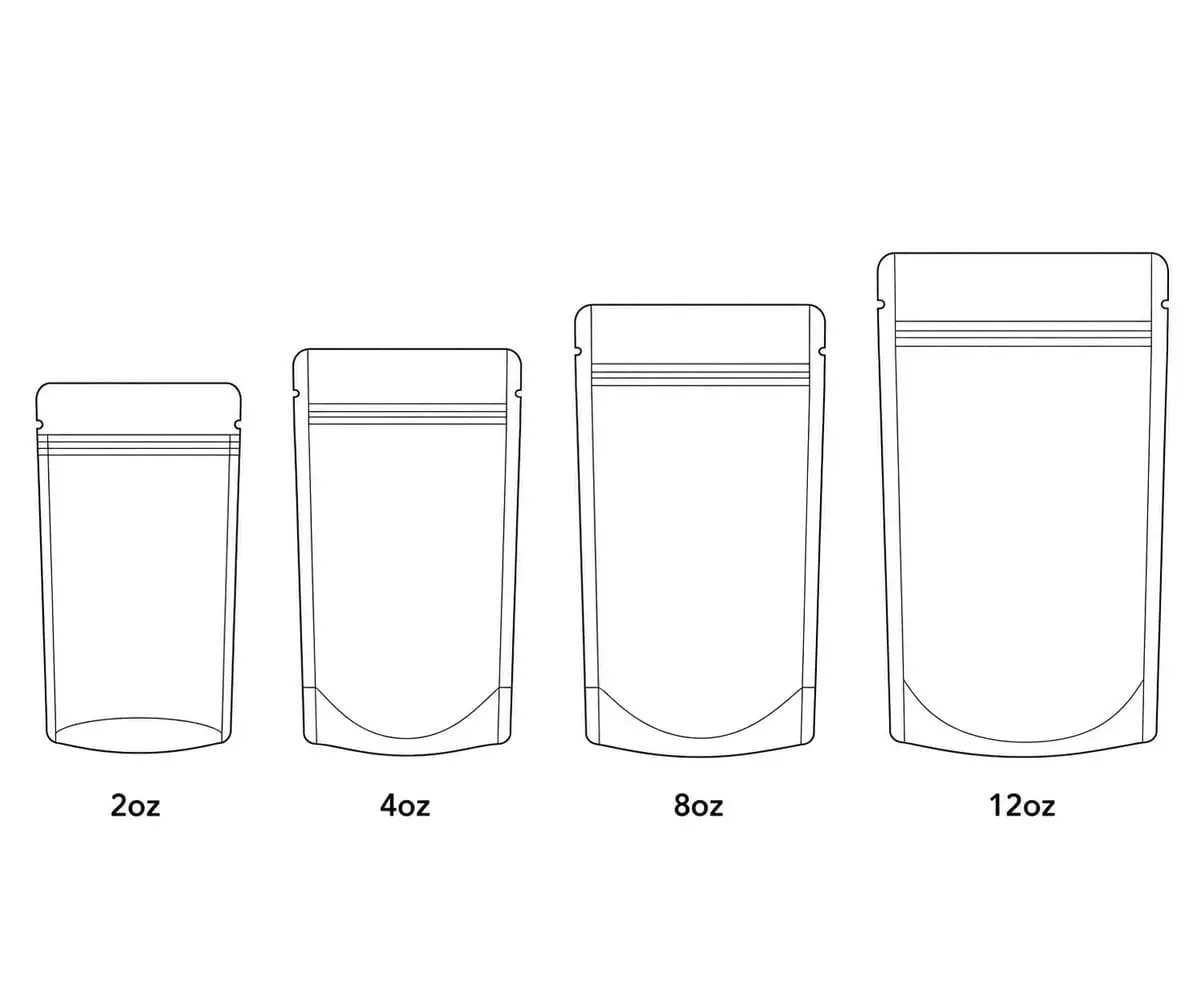
Planning Directions
Common planning directions include 2 oz sample coffee pouches, 4 oz trial packs, 8 oz retail coffee pouches, 12 oz coffee bags with valve, 16 oz / 1 lb coffee pouch projects, and 5 lb coffee bags with valve for larger project requirements. Note that final pouch size depends on coffee bean density, ground coffee density, fill weight, valve position, zipper position, bottom gusset depth, seal area, bag opening width, filling method, and carton packing method.
Filling Method Compatibility
- Manual Filling: Needs a stable opening and simple heat sealing area for operators to manage efficiently.
- Semi-Automatic Filling: Requires pouch dimension consistency and strict seal area control for pedal-operated sealers.
- Automatic Filling: Demands precise pouch tolerance, predictable opening behavior, accurate valve position, and repeat production stability for machine clamps and jaws.
| Coffee Pack Direction | Common Use | Pouch Feature to Review | Packaging Detail to Confirm |
|---|---|---|---|
| 2 oz / 4 oz | Sample / Trial packs | Tear notch, no valve | Opening width for easy filling |
| 8 oz / 12 oz | Retail shelves | Valve, Zipper, Bottom Gusset | Gusset depth for shelf standing |
| 16 oz / 1 lb | Retail / Subscription | Valve, Strong Zipper | Valve position relative to fill line |
| 5 lb | Wholesale / Cafe supply | Valve, Heavy-duty structure | Seal strength and film stiffness |
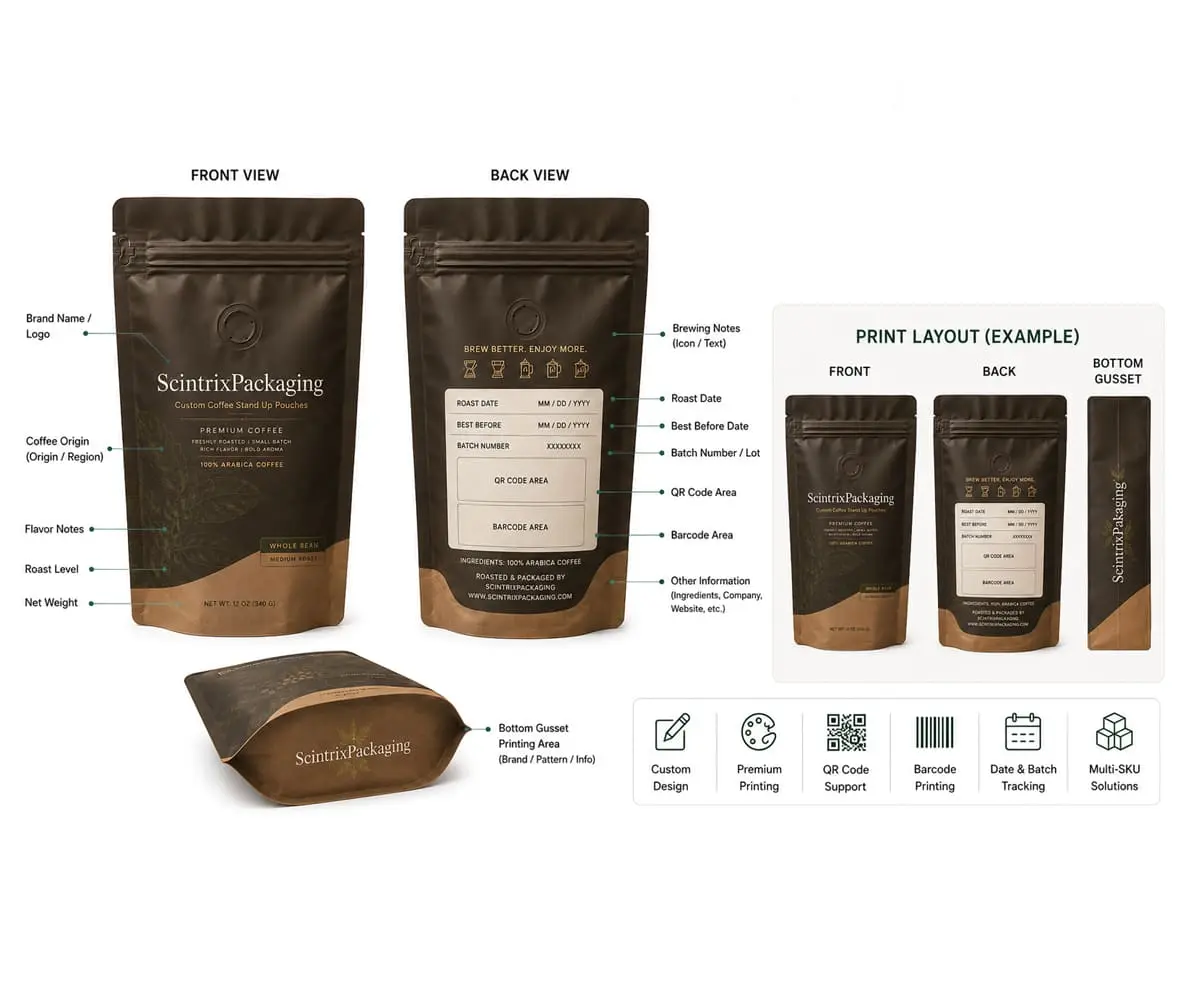
Custom Printing and Coffee Label Layout
Effective B2B coffee packaging requires clear communication. We support custom printing that integrates brand name, coffee origin, roast level, flavor notes, roast date, best before date, net weight, brewing notes, barcode, QR code, batch number, and subscription SKU details.
For multi-origin coffee brands, packaging artwork should keep origin, roast level, and flavor notes easy to identify while keeping barcode, roast date, and batch information readable after pouch forming and filling.
Printing Options
-
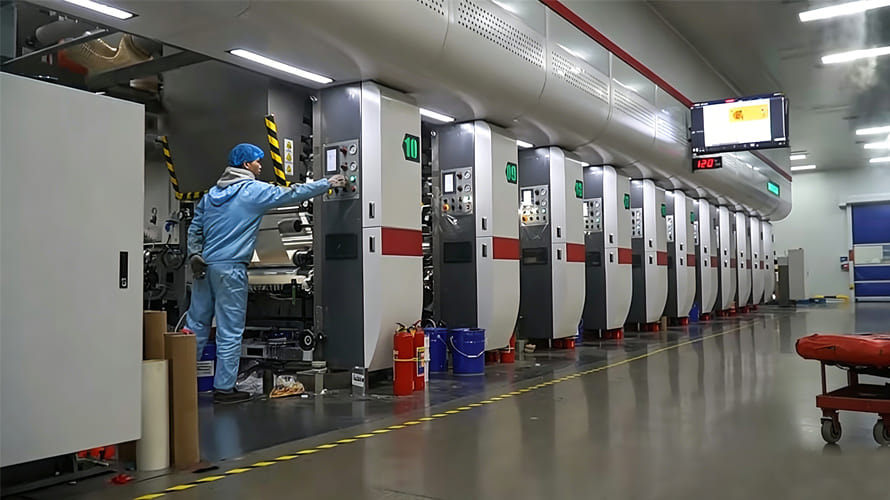
Rotogravure Printing:
Can be used for repeat production and consistent brand layouts, offering excellent color fidelity for large volume runs.
-
Digital Printing:
Can support shorter runs, multi-SKU trials, and seasonal coffee packaging when project requirements allow, reducing plate costs for complex origin variations.
Quality Control for Coffee Pouches
Before shipment, coffee stand up pouches should be reviewed against confirmed specifications. We verify material structure, pouch dimensions, zipper position, valve position, print registration, seal area, and bottom gusset standing condition.
Inspection Points:
Testing requirements should be confirmed according to coffee type, valve need, pouch format, filling method, storage condition, and transportation route.
Request Coffee Pouch Samples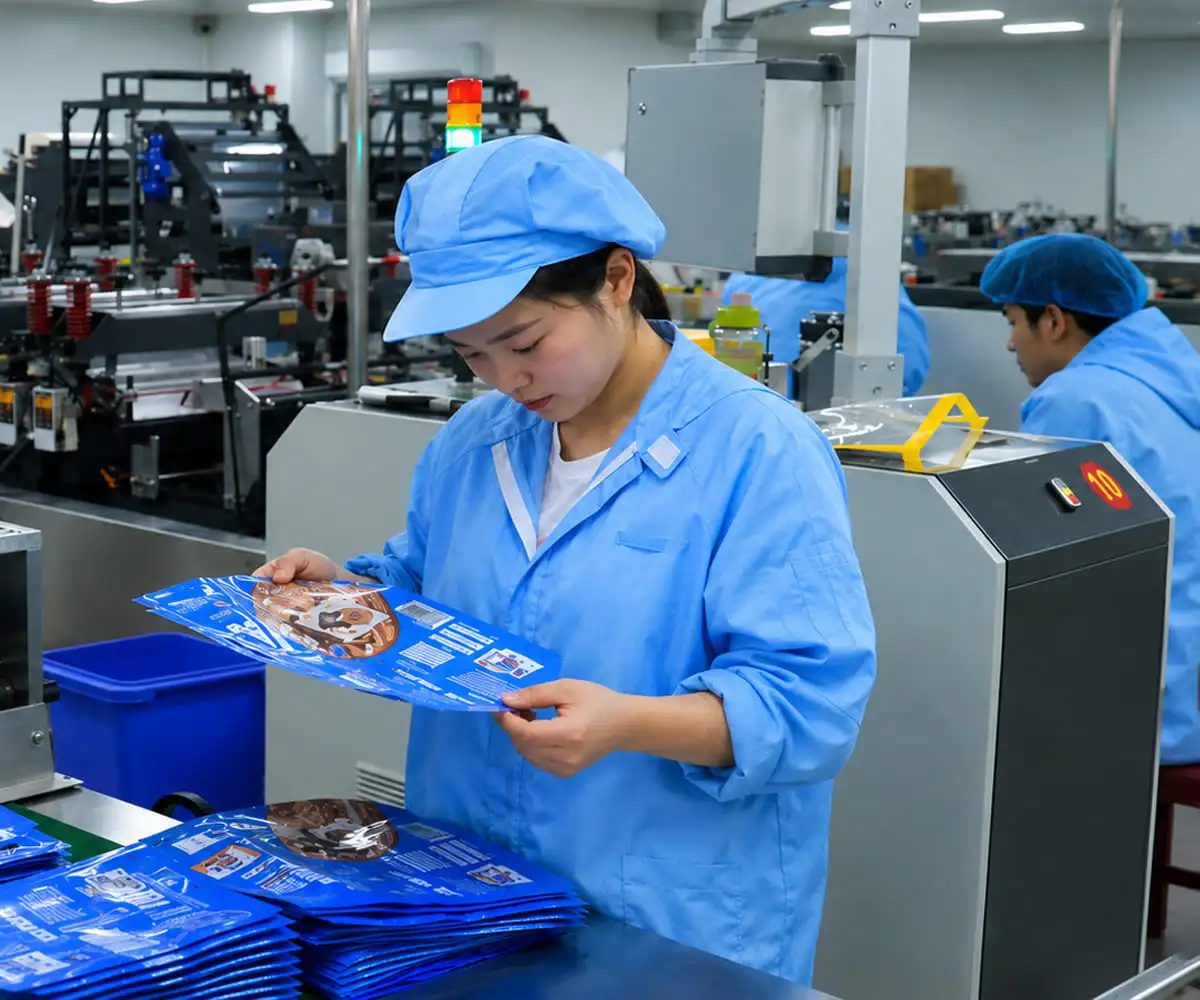
Why Coffee Brands Choose ScintrixPackaging
From artwork review and material selection to valve placement and final inspection, we help coffee brands reduce packaging risks before mass production.
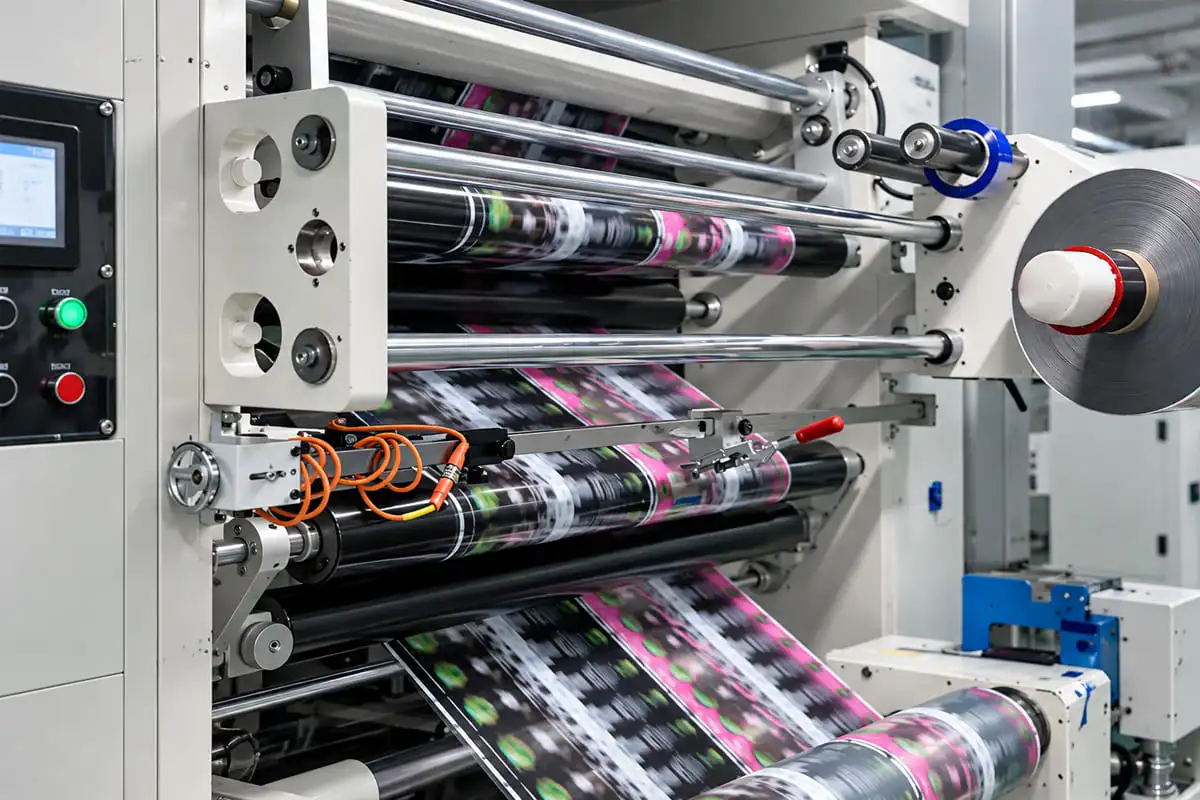
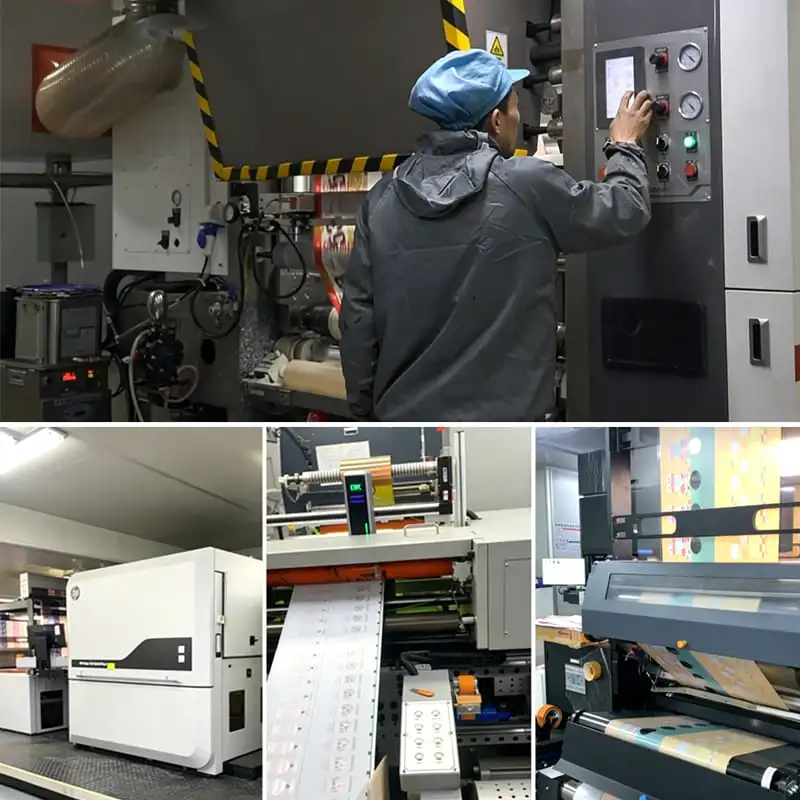
Coffee Pouch Production, From Printing to Final Inspection
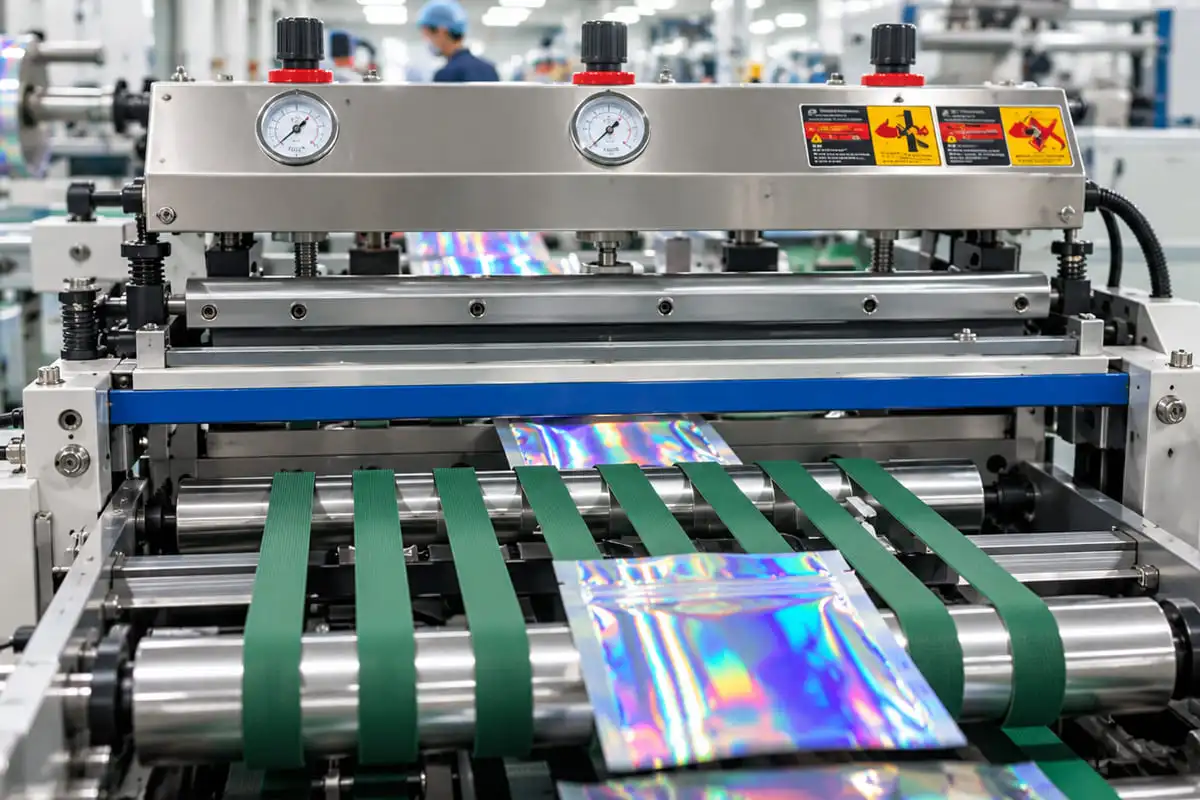
Pre-Production Sample Review
Review pouch dimensions, zipper and valve placement, bottom gusset structure, artwork positioning, and barcode readability before mass production.
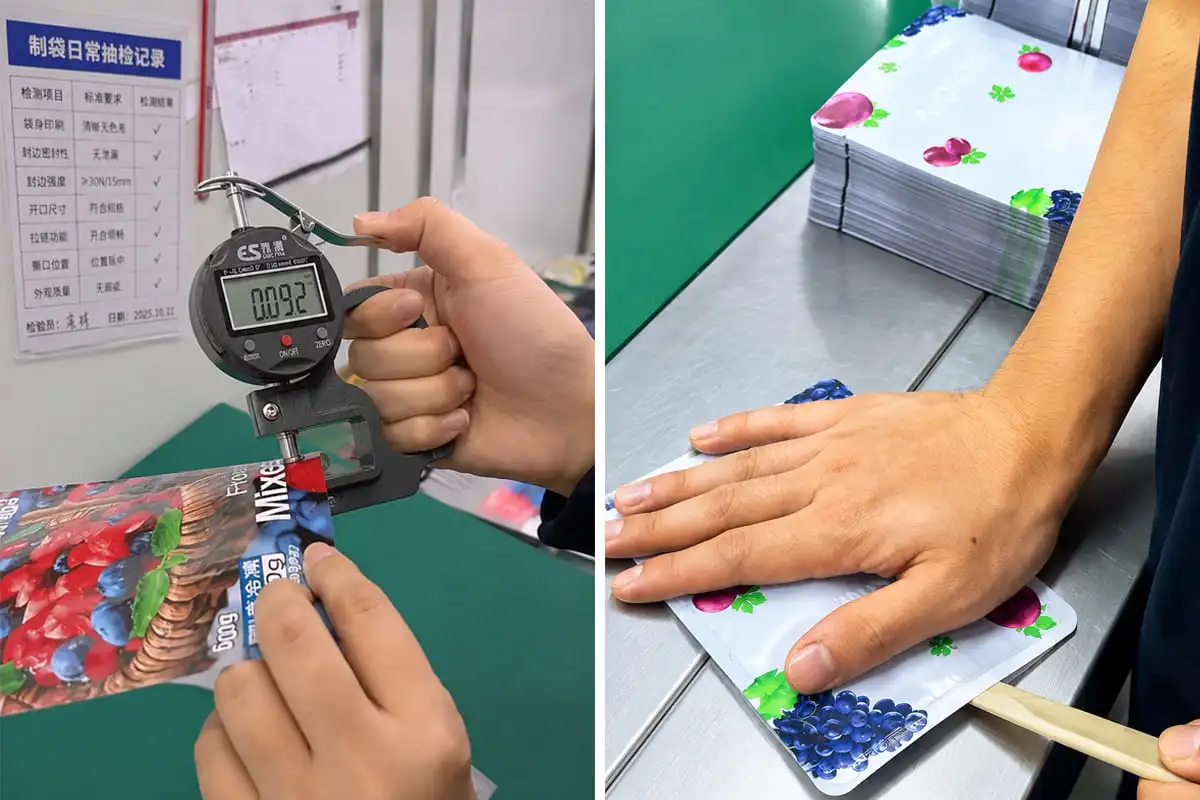
In-Process & Final Quality Inspection
Key pouch specifications are checked during production and before shipment to help maintain batch consistency.
• Dimensions & print registration
• Valve & zipper placement
• Seal integrity
• Finished pouch sampling
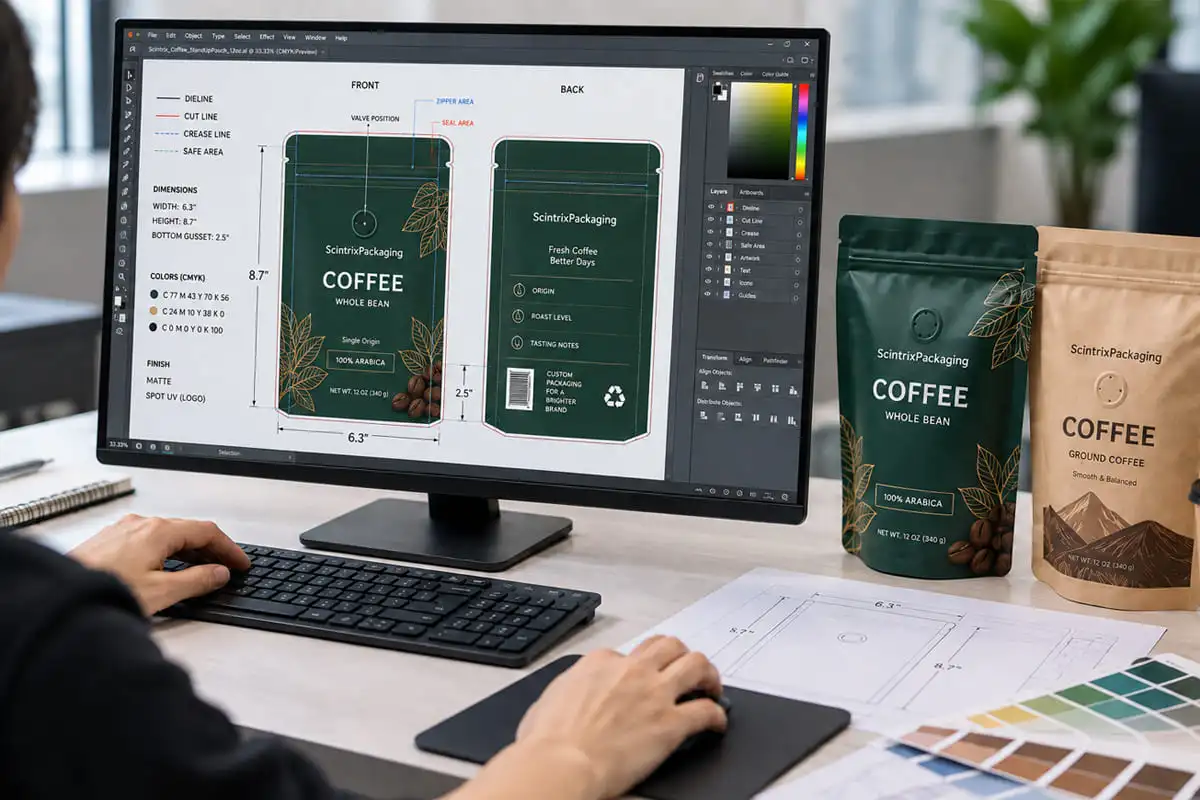
Responsive B2B Project Support
For multi-SKU coffee lines, private-label projects, and subscription brands, we can review artwork versions, pouch sizes, valve requirements, and filling methods before specifications are finalized.
How to Choose Coffee Stand Up Pouches
A step-by-step guide to defining your coffee packaging specifications.
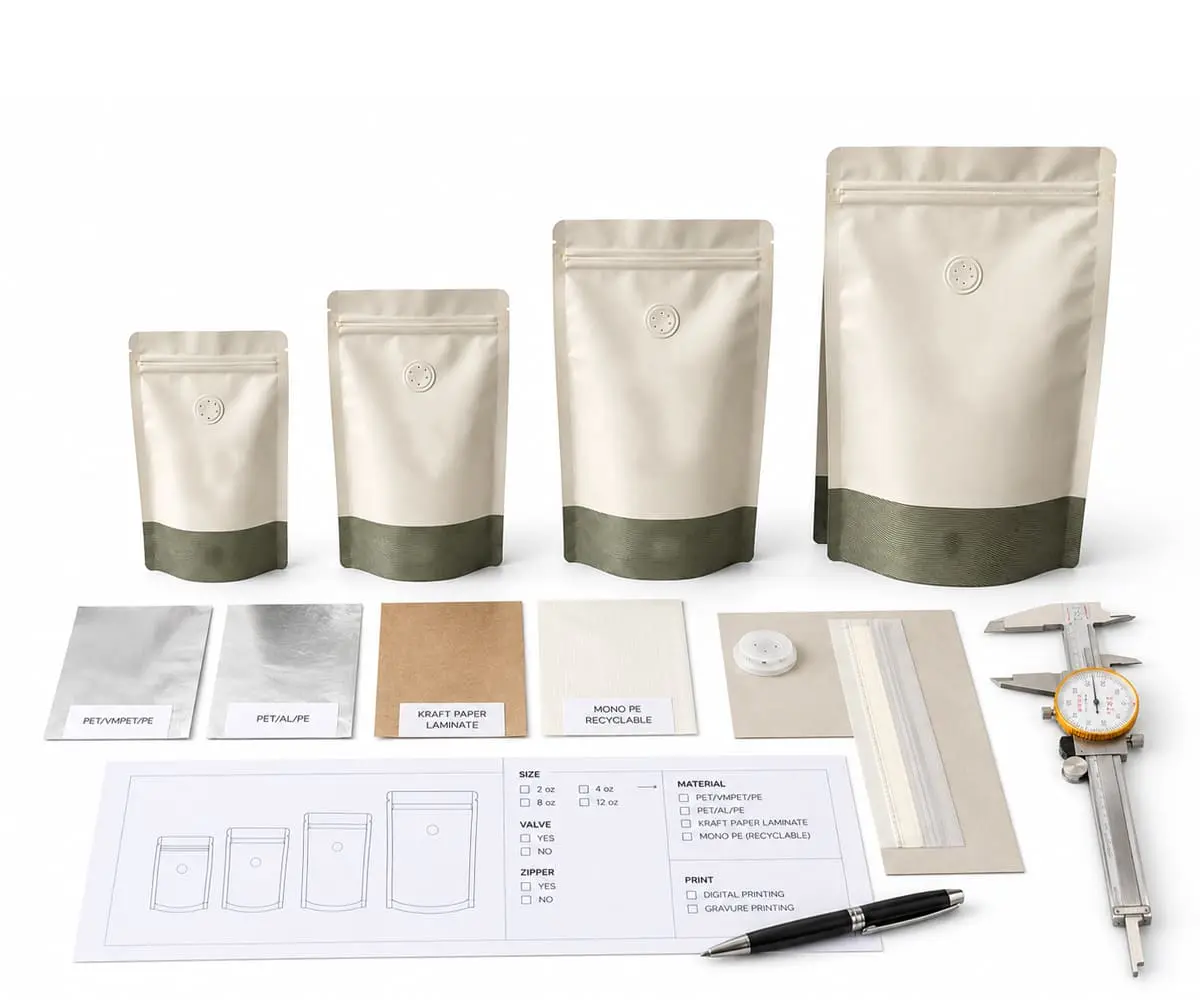
- Confirm the product: Is it whole bean coffee, ground coffee, flavored coffee, a sample pack, or subscription coffee?
- Confirm fill weight: Such as sample pack direction, 8 oz, 12 oz, 16 oz, 1 lb, or 5 lb project direction.
- Review sensitivity: Assess aroma sensitivity, oil content, roast level, oxygen exposure, and moisture exposure.
- Decide on a valve: Determine whether a one-way degassing valve is needed based on degassing time.
- Confirm physical features: Zipper, tear notch, transparent window, and bottom gusset requirements.
- Select material structure: Such as PET/VMPET/PE, PET/AL/PE, or kraft laminate.
- Prepare artwork: Include origin, roast level, flavor notes, roast date area, barcode, and QR code.
- Review layout: Check pouch size, valve position, zipper placement, and seal area against the artwork.
- Approve sample: Review a sample pouch or printed proof before mass production.
- Confirm production details: Align filling, sealing, carton packing, and repeat production requirements.
| Coffee Product | Recommended Pouch Direction | Key Feature | Material Direction | Validation Step |
|---|---|---|---|---|
| Whole bean coffee | Stand up pouch with valve | Degassing valve | PET/VMPET/PE | Valve position check |
| Ground coffee | Stand up pouch, no valve | Strong seal area | PET/AL/PE | Zipper dust check |
| Freshly roasted coffee | Pouch with valve & zipper | Valve + Barrier | High barrier laminate | Roast date print area |
| Sample coffee packs | Small stand up pouch | Tear notch | PET/VMPET/PE | Fill opening width |
| Retail coffee pouches | 12 oz / 16 oz stand up pouch | Bottom gusset | Printed laminate | Shelf standing test |
| Subscription coffee pouches | Mailer-friendly stand up pouch | Multi-SKU printing | Digital / Roto print | Box fit dimension |
| Kraft coffee packaging | Kraft stand up pouch | Natural look | Kraft/VMPET/PE | Print color on kraft |
| Foil coffee packaging | Foil stand up pouch | Opaque barrier | PET/AL/PE | Flex cracking review |
Frequently Asked Questions
1. What are coffee stand up pouches?
2. Are stand up pouches suitable for whole bean coffee?
3. Are stand up pouches suitable for ground coffee?
4. Do coffee stand up pouches need a valve?
5. What does a one-way degassing valve do for coffee packaging?
6. Can coffee stand up pouches have a resealable zipper?
7. What materials are used for coffee stand up pouches?
8. Are kraft coffee stand up pouches suitable for coffee beans?
9. Are foil coffee stand up pouches better for aroma protection?
10. Can coffee stand up pouches have a transparent window?
11. What sizes are available for coffee stand up pouches?
12. Can I customize printed coffee stand up pouches for multiple origins?
13. What should be printed on coffee stand up pouches?
14. How do I choose between coffee stand up pouches and flat bottom coffee bags?
15. What information is needed for a coffee pouch quotation?
Develop Coffee Stand Up Pouches for Aroma Protection, Valve Function and Retail Shelf Display
Ready to finalize your coffee packaging specifications? Leave your contact info and a quick note, and our experts will reach out to discuss material structures and custom print layouts.